
A manual of off-grid food and water preservation — the pre-refrigeration methods for keeping meat, produce and water usable without a working freezer. One-time payment with the standard 60-day ClickBank refund window.
Affiliate link: we earn a commission if you buy, at no extra cost to you. The description above comes from the seller’s own page and we have not independently verified it. Details
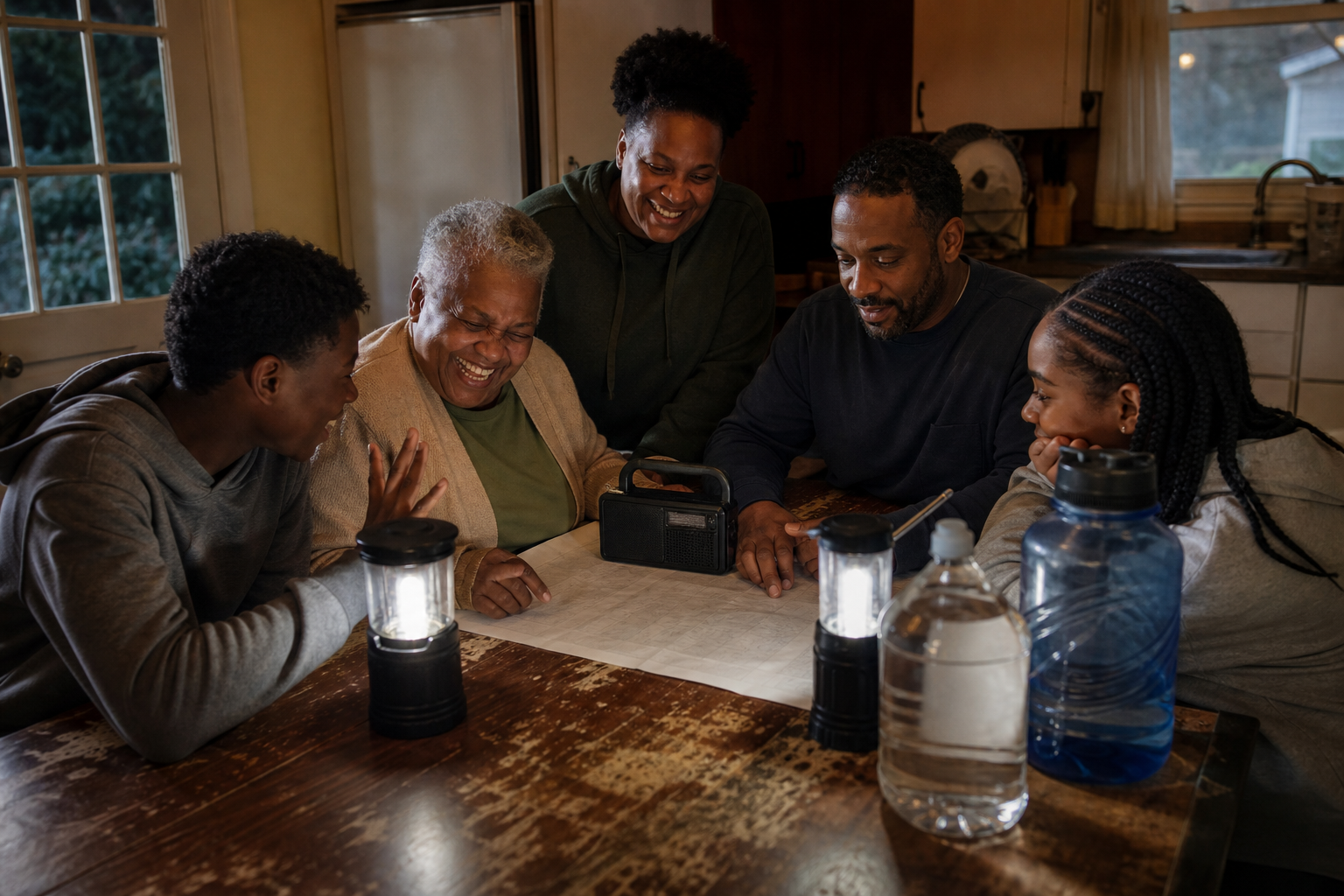
See what’s inside →A two-week plan is the sweet spot. Three days is a storm and a cooler of ice. A year is a lifestyle change, not a purchase. Two weeks is the outage that actually happens — a derecho, an ice storm, a hurricane that takes out distribution across three counties — and it is long enough that the sequence in which things fail starts to matter.
The order below is deliberate and it is the reverse of how most people buy. Water, food, heat, sanitation, power. Power is last because it is a means, not an end, and because buying a generator before you know what you need it to run is how people end up with the wrong generator.
One: water
If you are on a well, this is the whole problem in one sentence: your water is electric. The submersible pump 200 feet down stops the instant the power does, and the pressure tank in your basement holds enough for maybe one or two flushes. There is no reserve.
The planning figure everyone quotes is one gallon per person per day. That is a drinking-and-cooking survival minimum and it is not how a household actually behaves. Add washing, dishes, and flushing and real consumption is more like three to five gallons per person per day. For a family of four over fourteen days, one gallon each is 56 gallons; a realistic household number is closer to 170.
Cover it in three layers. Fill the bathtub the moment a warning comes in — that is 30 to 50 gallons of flush water for free. Keep a standing reserve in food-grade drums or stackable containers; our guide to emergency water storage goes through what does and does not survive being stored. And have a way to get more: a hand pump matched to your well depth, a generator sized to start the pump, or a rain catchment setup. Getting water from a source you own beats storing it, because storage runs out on a schedule.
Two: food
Your food problem in the first week is not scarcity, it is the freezer. USDA guidance is that a full freezer holds safe temperature for about 48 hours unopened, and a half-full one for about 24. A refrigerator holds about 4 hours.
So the first 48 hours are a decision, not a wait. Either you get power to the freezer — this is the single highest-value load in the house and it is why so many people size a generator around it — or you start cooking and preserving. That is the moment when knowing how to can, dry or salt what is in there stops being a hobby and starts being worth several hundred dollars. We go through the timing in detail in how long food lasts in a freezer without power.
Beyond the freezer, the two-week pantry is easy and boring: shelf-stable food you already eat, a manual can opener, and a way to cook that does not depend on the grid. Do not build a two-week plan around food your family has never tasted.
Three: heat (or cooling)
The most common surprise in a winter outage: the gas furnace stops even though the gas is still flowing. It stops because the blower motor, the ignition board and the thermostat all need line power. There is nothing wrong with your fuel supply. That is also why the fix is small — a furnace blower is a modest load and running a gas furnace on a battery is well within reach of a mid-sized power station.
A wood stove is the other answer, and in a two-week winter event it is the better one, because it needs nothing from anybody. If you have one, the question is whether you have enough seasoned wood stacked and ready — not whether the stove works.
Whatever you use, plan to heat one room rather than the house. Close doors, hang blankets over stairwells, and put everyone in the same space. It is the difference between a comfortable two weeks and a cold one.
Safety: Never run a generator, charcoal grill or unvented combustion heater indoors, in an attached garage, or in a basement — carbon monoxide is the leading cause of death in extended outages and it gives no warning. Have working battery CO alarms on every level. See detector placement and failure modes.
Four: sanitation
This is the one nobody plans and everybody regrets. On a septic system the tank does not care about power, but the toilet does — a flush is a gallon and a half of your stored water, and after a dozen of those you are choosing between drinking and flushing.
A bucket toilet with sawdust costs under eighty dollars, sits in the garage until needed, and removes the whole problem. Add trash bags, disinfectant wipes, hand sanitizer and a way to wash hands with a small amount of water. Two weeks of four people in a house with no sanitation plan turns into an illness problem by about day five, and that is a far more likely harm than anything dramatic.
Five: power
Now that you know what has to run, size the thing. Over two weeks the loads that matter are the well pump, the freezer, the furnace blower, and a short list of small things — phones, a radio, lights, and any medical equipment. Everything else is comfort.
The well pump is usually what sets the size, because a half-horsepower submersible can demand 2,000 to 3,000 watts at startup even though it runs on far less. Work through what size generator your house needs before shopping, and settle the connection question — an interlock kit or a transfer switch — at the same time, because extension cords through a window do not reach the well pump or the furnace.
Fuel is the two-week constraint people miss. A generator running 8 hours a day for 14 days at half load is a large amount of gasoline, and gasoline goes stale. Rotate it, stabilize it, and consider a dual-fuel unit so propane — which stores indefinitely — is on the table.
How the two weeks actually go
| Window | What changes | What it demands |
|---|---|---|
| Hours 0-4 | Fridge is on the clock | Fill tub, stop opening doors |
| Hours 4-48 | Freezer decision point | Power to it, or start preserving |
| Days 2-4 | Stored water dropping fast | A resupply method, not more jugs |
| Days 3-5 | Sanitation becomes the issue | Bucket system, waste bags |
| Days 5-10 | Fuel and routine | Rationing runtime, refueling plan |
| Days 10-14 | Morale and monotony | Familiar food, light, information |
Notice how little of that is dramatic. Two weeks without power in a well-prepared house is mostly tedium punctuated by chores. The households that struggle are the ones improvising water and sanitation on day four while also trying to figure out a generator they have never started.
On the preservation side
If the freezer question is the one that worries you, the older methods are worth knowing before you need them. The Lost Frontier Handbook is a manual of off-grid food and water preservation — the pre-refrigeration approaches to keeping meat and produce usable. Treat it as a reference on technique rather than a preparedness plan; it will not tell you how to wire a transfer switch or size a pump, and anyone looking for that kind of installation detail should look elsewhere. What it covers, it covers in the sort of depth that only matters on day three.
Where I’d start tomorrow
If you did exactly three things this month: put 60 gallons of water in storage, build the bucket toilet, and start your generator and run it under load for twenty minutes. Those three cost a couple of hundred dollars combined and they address the three failures that make a two-week outage genuinely bad. Everything else on this page can wait for next month.
Amazon affiliate links follow. As an Amazon Associate I earn from qualifying purchases, at no extra cost to you. Details
Kidde sealed ten-year CO alarm on Amazon →
Energizer LED headlamps, 4-pack, on Amazon →
NOAA hand-crank weather radio on Amazon →
As an Amazon Associate I earn from qualifying purchases.
Affiliate link: we may earn a commission if you buy.
How many days could your house really manage? A free 20-question assessment from the seller of the 3-7-30 Household Resilience Plan scores eight areas of your household and points to what to fix first. Your results are unlocked with your email and consent to the seller’s marketing emails.
Frequently Asked Questions
How much water do I need for two weeks?
One gallon per person per day is the survival minimum for drinking and cooking — 56 gallons for a family of four over two weeks. Add washing and flushing and plan closer to three gallons per person per day, or about 170 gallons, unless you have a resupply method.
Should I buy a whole-house standby generator for this?
Only if outages are frequent where you live or somebody in the house depends on powered medical equipment. For an occasional two-week event, a portable unit plus an interlock kit does the same job for a fraction of the installed cost.
Does my septic system stop working without power?
A conventional gravity septic system keeps working — it has no pump. Systems with an effluent pump or an aerobic treatment unit do need power, and they will back up. Find out which kind you have before you need to know.
What about summer outages?
Same order, different fourth item. Heat exhaustion in an un-air-conditioned house is a real hazard for older adults. Plan for shade, cross-ventilation, and enough power to run a couple of fans — which is a far smaller electrical problem than air conditioning.
What to Read Next
- How to Prepare for a Long Power Outage
- What Breaks First When the Grid Goes Down
- Well and Septic vs City Water: Two Different Preps
- Start here if this is all new
One link on this page is an affiliate link. If you buy through it, Failsafe Home earns a commission and you pay exactly the same price. It does not influence what makes it onto the page or what we warn you away from — see the affiliate disclosure.