
When The Tap Stops
Water
Well pumps, hand pumps, storage, rainwater and filtration — what each one really delivers per day, and what it costs.
If your water comes from a well, your water is an electrical appliance. The pump sits at the bottom of the borehole and it does not care that the fuel tank outside is full; when the grid drops, the tap gives you whatever is left in the pressure tank and then nothing. Most pressure tanks hold something like 5 to 20 gallons of usable drawdown, which is one shower or a couple of toilet flushes. That is the entire margin.
How a household water supply fails
There are three distinct failure modes and they need different answers. The first is loss of power with the well intact — solved by backup power or by a manual way to reach the water. The second is loss of pressure on a municipal system, which often comes with a boil-water notice because contamination can enter the mains once pressure drops. The third is contamination of the source itself, from flooding or a failed septic field, which no amount of stored electricity fixes.
Plan for a realistic volume rather than a survival minimum. One gallon per person per day is the standard emergency figure for drinking and basic cooking, but a household that also wants to wash, flush occasionally and water livestock is closer to 5-10 gallons per person per day. The gap between those two numbers is where most plans quietly fail on day three.
The four ways to keep water coming
- Run the pump on backup power. Cleanest solution if your equipment can handle the surge. A 1/2 HP submersible typically runs on 800-1,000 W but demands 2,000-3,000 W at startup, which rules out smaller battery stations. Sizing is covered in Power & Backup.
- Deep-well hand pump. A stainless hand pump such as those from Bison Pumps or Simple Pump installs alongside the existing submersible and works to depths that ordinary pitcher pumps cannot reach. Expect roughly $1,000-$2,500 plus installation at the time of writing, and expect real effort — a few gallons per minute of pumping, not a tap.
- Stored water. The cheapest and least glamorous option, and the one with the best return. Food-grade containers such as WaterBrick stackables, or a 55-gallon drum in a cool dark corner, cover the first several days with zero moving parts.
- Rainwater. Roughly 600 gallons per inch of rain per 1,000 square feet of roof, before losses. Excellent for flushing, washing and livestock; treat it before drinking, and check your state and county rules, which vary more than people expect.
Storage and filtration, in numbers
| Option | Rough cost at the time of writing | What it covers |
|---|---|---|
| Pressure tank drawdown | already installed | 5-20 gallons — hours, not days |
| Six 3.5-gal stackable containers | $120-$200 | About 21 gallons — 4 days drinking for a family of four |
| 55-gallon drum + siphon pump | $100-$180 | Roughly two weeks of drinking and cooking |
| Gravity countertop filter (Berkey class) | $250-$400 | Continuous drinking water from questionable sources |
| Hollow-fiber personal filter (Sawyer, LifeStraw) | $25-$45 | Backup and go-bag use; bacteria and protozoa, not viruses or chemicals |
| Rain barrels, three-barrel setup | $150-$400 | 150-165 gallons of non-potable supply per fill |
One distinction worth being precise about: filtration and disinfection are not the same thing. A hollow-fiber filter removes bacteria and protozoa mechanically but does not touch dissolved chemicals or, in most cases, viruses. Boiling for one minute at a rolling boil handles biological contamination but concentrates anything chemical. If your concern is a flooded well near a failed septic field, the answer is a different source, not a better filter.
What to do first
Store water before you buy anything else. It is the only item in home resilience where a couple of hundred dollars buys you a genuinely large fraction of the problem. Then decide, using your own load numbers, whether backup power or a hand pump is the better way to reach the well. Then add filtration, sized to the source you would actually fall back on.
Water also drives the two systems on either side of it. Without water you have a sanitation problem within a day or two, covered in Sanitation. If your pipes are at risk of freezing, draining and heating decisions interact — see Heat & Cold. Garden and livestock demand belongs in Grow Your Own, and the whole-house view of well, tank and septic is in The House. New to all of this? Begin at Start Here.
Latest in this section
- Long Term Water Storage Without It Going Bad
 Water does not spoil, but stored water does. Container prep, bleach ratios, the six-month rotation rule and why plastic in a garage tastes like the garage.
 - Storing Water in 55-Gallon Drums
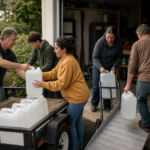 A full 55-gallon water barrel weighs about 480 pounds. Here is where to put it, how to treat and rotate the water, and how to get it back out.
 - Gravity Water Filter Systems for a House Without Power
 A gravity water filter runs with no pump and no power. Here is how fast they really are, what they remove, and how to size one for a whole household.
 - Testing Well Water: What and How Often
 Well water testing without the guesswork: which contaminants to check every year, which every few years, what a lab panel costs, and how to read the report.
 - Is Rainwater Safe to Drink? Roof, Filter, Risk
 Rainwater is clean when it falls and dirty by the time it reaches your barrel. Here is what your roof adds, and the filter chain that removes it.
 - Is Collecting Rainwater Illegal in Your State?
 Collecting rainwater is legal in most of the US. Only a few states set real limits, and Colorado, Utah and Nevada are the ones you should read first.
 - Emergency Water Storage That Actually Works
 How much emergency water to store, what to store it in, where to put it so the floor holds, and how often it really needs rotating. With the weights.
 - Hand Pumps for Wells: Matching Your Depth
 A hand pump for a well only works if it matches your static water level. Depth limits, real costs, sharing a casing, and where the marketing stops.
 - When Your Well Loses Power: What to Do
 Your well pump is dead and the tap still runs for a minute. Here is exactly how much water is left, what to do first, and how to get more.