
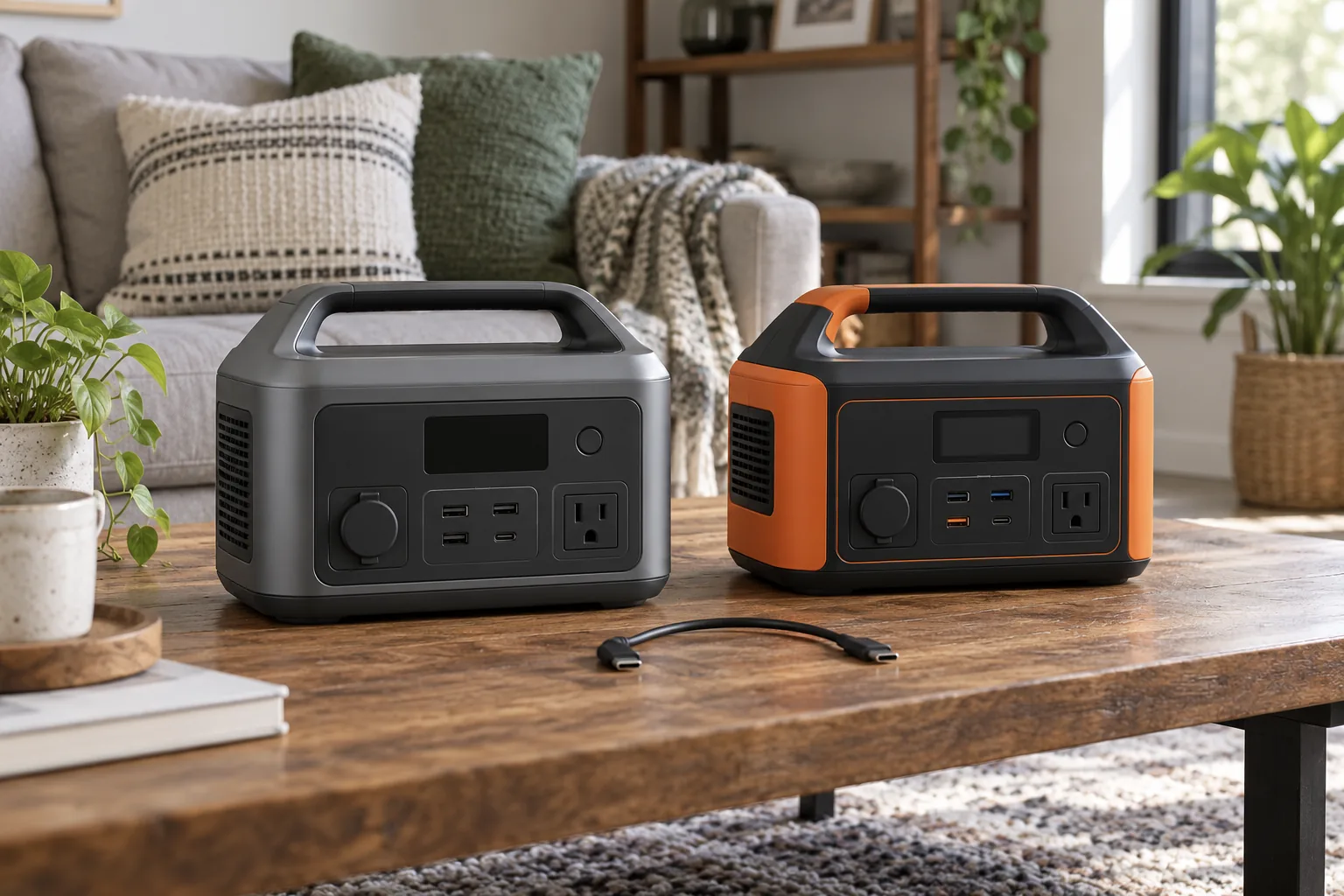
Both brands sell competent boxes. Buying the wrong capacity costs far more than buying the wrong logo, and almost everyone buys too small.
Size a power station properly →Jackery vs EcoFlow is the comparison that comes up in every power station thread, and it is usually argued on the wrong terms — color, app polish, which YouTuber got the sponsorship. For backing up an American house with a well pump, a furnace and a full freezer, four specifications decide it: continuous AC output, cell chemistry, recharge time and warranty. Both brands have converged on lithium iron phosphate cells, so the fight is narrower than it was three years ago and comes down to inverter headroom and how you plan to refill the box.
Head to Head at the 2 kWh Size
The Jackery Explorer 2000 v2 and the EcoFlow Delta 2 Max are the closest matched pair in the two brands’ lineups, and near-identical on paper.
| Spec | Jackery 2000 v2 | EcoFlow Delta 2 Max |
|---|---|---|
| Capacity | 2,042 Wh | 2,048 Wh |
| Continuous AC | 2,200 W | 2,400 W |
| Surge | 4,400 W | 4,800 W |
| Chemistry | LiFePO4 | LiFePO4 |
| AC recharge | ~1.5 h | ~1.4 h |
| Weight | ~40–46 lb | ~50 lb |
| Warranty | 3 yr, extendable to 5 | 5 yr |
Street prices at the time of writing in August 2026 move constantly. Both carry list prices around $1,900 to $2,000 and both are discounted hard and often — the Jackery has been seen well under $1,000 during sale events. Never pay list for either. Watch for a month before buying and you will save several hundred dollars.
Continuous Output Is the Spec That Matters
Capacity tells you how long. Continuous watts tell you whether it turns on at all. A 2,200 W inverter runs a refrigerator, a chest freezer, a gas furnace’s blower and lights simultaneously with room to spare — those are a few hundred watts each. It will not run a well pump and a furnace at the same time, and it will not run a central air conditioner or an electric water heater at all.
The 200 W difference between these two units is not decisive. Surge capacity is more interesting: a 1/2 HP well pump demands roughly 2,000 to 3,000 W for the fraction of a second it starts, and both units’ surge ratings cover that on paper. In practice, motor starting is where portable inverters fail unpredictably, and neither brand will guarantee your specific pump.
EcoFlow’s X-Boost mode advertises 3,400 W continuous on this unit, and it deserves a caveat. X-Boost works by reducing output voltage so a higher-wattage appliance draws within the inverter’s limits. That is fine for a resistive load like a space heater or a kettle, which simply runs cooler. It is not fine for motors, compressors or anything with sensitive electronics, which can overheat or misbehave on low voltage. Do not size your backup plan around the boost number.
Chemistry: Effectively a Tie Now
Both brands use LiFePO4 across their current lineups, and both rate over 3,000 cycles. The fine print differs in a way worth noticing: EcoFlow generally quotes cycles to 80% of original capacity, Jackery to 70%. Same cycle count, different finish line, so EcoFlow’s rating is the more conservative claim.
For a home backup unit this is largely academic. A box that gets cycled during four outages a year will hit calendar aging long before cycle count. What LiFePO4 buys you over the older NMC chemistry is real, though: far better tolerance of sitting at high state of charge for months, which is exactly what a backup battery does for 360 days a year.
Recharge Speed and Switchover
EcoFlow’s reputation is built on charging fast, and across the lineup it holds — comparable models generally refill quicker than Jackery equivalents, sometimes by a wide margin at the smaller sizes. At this particular pairing the gap has closed to minutes.
Two real caveats. Fast AC charging makes both units noisy — cooling fans at full tilt, in a room you may be trying to sleep in. And rapid charging is only useful if you have power to charge from, which during a multi-day outage means a generator or solar. If your plan is “charge it from the wall between outages,” a 1.4 hour charge and a 3 hour charge are the same thing.
Switchover matters more than most buyers realize. EcoFlow’s UPS mode transfers in under 10 milliseconds; Jackery’s EPS mode is around 20 ms. Under 10 ms will hold up a desktop computer, a network stack or a modem without rebooting. Twenty milliseconds is marginal for that and fine for everything else. If keeping a CPAP or a home office alive through the transition is the goal, this is the spec to buy on.
Where Each One Loses
- Jackery: baseline warranty is 3 years and only reaches 5 through registration or an extension, which is a downgrade dressed as a promotion. Several models are also fixed-capacity — you cannot bolt on a second battery later, so outgrowing your unit means buying a whole new one.
- EcoFlow: heavier for the same energy, and the product line churns fast enough that the model you research is often superseded before it arrives. The app is capable and more complicated than it needs to be, and X-Boost invites people to plan around output the unit cannot actually deliver cleanly.
- Both: neither is a whole-house solution. Powering circuits rather than extension cords means a transfer switch or a smart panel, which is an electrician’s job and a separate budget line.
And a shared reality: 2 kWh is about one day of a refrigerator plus a furnace blower plus phones and lights, not a week of normal living. Everyone underestimates this. Metering your actual house is the cheapest thing you can do before spending two thousand dollars.
Which One We’d Pick
For a house with land, we would lean EcoFlow — not for the charging speed, but for the 5-year warranty as standard, the sub-10 ms transfer and the option to expand capacity later. Expandability is the one that saves money over a decade, because the first outage that outlasts your battery is the one that teaches you how much you actually needed.
Jackery wins on one axis that is not nothing: weight. Six to ten pounds sounds trivial until you are carrying the thing from the basement to the well house in the dark. If the unit is going to move around your property rather than sit next to the panel, and the discount is steep enough, take the Jackery and stop reading comparison articles.
Frequently Asked Questions
Can a Jackery or EcoFlow run a well pump?
A 2 kWh unit with 4,400 W or more of surge can often start a 1/2 HP pump, but it is not guaranteed and it drains the battery quickly. Well pumps are the load that most often defeats a portable power station.
How long will 2,000 Wh run a refrigerator?
A modern fridge uses roughly 1 to 2 kWh a day, so a full 2 kWh unit gives you about one to two days running only the fridge, less once you add anything else.
Is EcoFlow’s X-Boost safe to use?
It is designed to be, on resistive loads like heaters and kettles that tolerate lower voltage. Avoid it for motors, compressors, medical equipment and anything with sensitive electronics, and never size your plan around the boosted figure.
Do these replace a generator?
For a few hours or one overnight, yes, and far more quietly. For a multi-day outage, no — the battery empties and needs a generator or solar to refill it. Most houses with land end up with both.
What to Read Next
- Portable power station for home backup sizing — the watt-hour math before the brand argument.
- How long a battery runs your refrigerator — the load everyone starts with.
- Running a gas furnace on a battery — the winter case that justifies the purchase.
- Solar generator for home: what the name hides — why the panels are the slow part.