
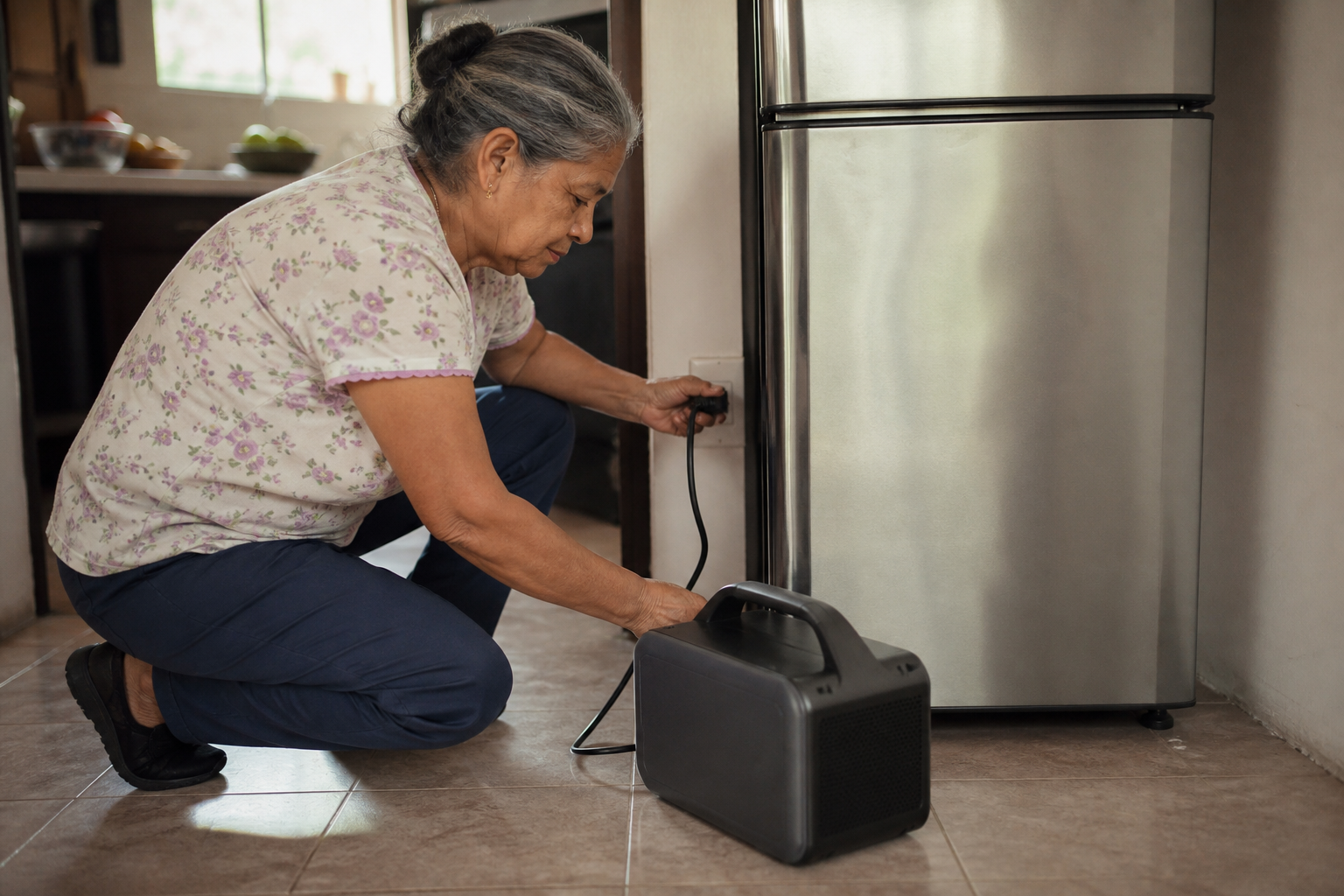
A $25 plug-in meter left on the fridge for 48 hours gives you the one number every runtime calculation depends on. Our audit guide shows exactly what to log.
Run the audit first →How long a battery runs your refrigerator is the question people get wrong in both directions. Some assume a 1,000 Wh power station dies in five hours because the fridge is “a 200-watt appliance.” Others assume it lasts a week because the compressor is quiet. The truth sits in between and is easy to calculate, once you accept that a refrigerator is off most of the time.
Start With the Yellow Label, Not a Calculator
Every refrigerator sold in the US carries an EnergyGuide label with an estimated annual consumption in kilowatt-hours. Divide by 365 and you have daily kilowatt-hours, which is the only input that matters. A current Energy Star full-size unit typically lands somewhere around 350 to 500 kWh per year, which is roughly 1.0 to 1.4 kWh per day. A twenty-year-old side-by-side can be double that.
The label is a laboratory figure and your kitchen is not a laboratory. A fridge in a hot garage, packed badly, with a door opened forty times a day, will beat its label by a wide margin. If you want the real number, put a plug-in energy meter on it for two full days and read the kWh directly. That is the single most useful measurement in the whole home energy audit.
Why Watts and Watt-Hours Tell Different Stories
Clamp a meter on a running refrigerator and a modern unit reads roughly 100 to 200 watts. Wait ten minutes and it reads close to zero. The compressor runs, pulls the box down to setpoint, and shuts off. Across a normal day it might be running something like a third of the time — less in a cool room, considerably more in a hot one or right after a big grocery load.
So a fridge that reads 150 W on the meter at that moment is consuming an average of about 50 W around the clock, which is 1.2 kWh per day. That gap between instantaneous watts and average watts is the whole reason batteries do better on refrigerators than people expect.
The Surge That Trips Small Inverters
A refrigerator compressor is an induction motor starting against a pressurized system. For a fraction of a second at each start it draws several times its running current — commonly in the range of 600 to 1,200 watts for a domestic unit, sometimes more on older compressors with a worn start relay.
This is why a small inverter rated 300 W continuous with 600 W surge can run a fridge for an hour and then trip when the compressor restarts against high head pressure. Look for at least 1,000 W continuous and 2,000 W surge, and treat any battery whose surge rating is only double its continuous rating with suspicion. Inverter-driven refrigerators, increasingly common on newer models, soft-start and largely avoid this problem — another reason to read your own nameplate rather than a generic chart.
The Math, Worked Out
Runtime equals usable battery watt-hours divided by average daily consumption. Two corrections keep it honest: usable capacity is typically 85 to 90 percent of nameplate after inverter losses, and the inverter itself burns something like 5 to 20 watts just being on, which is 120 to 480 Wh a day of pure overhead.
| Battery (nominal) | Efficient fridge (1.2 kWh/day) | Older fridge (2.4 kWh/day) |
|---|---|---|
| 500 Wh | roughly 8 hours | roughly 4 hours |
| 1,000 Wh | roughly 16 hours | roughly 8 hours |
| 2,000 Wh | roughly 32 hours | roughly 16 hours |
| 3,600 Wh | roughly 2.5 days | roughly 1.2 days |
Those figures already deduct a realistic 10 W of inverter overhead. Add solar input and the picture changes completely: 400 watts of panels in decent sun will roughly cover an efficient refrigerator’s entire daily draw, which turns a two-day battery into an indefinite one as long as the weather cooperates. Sizing that combination is covered in portable power station sizing for home backup.
Five Ways to Stretch the Runtime
- Stop opening it. Decide what you need, open once, close. Every opening dumps cold air and buys the compressor another cycle.
- Fill the empty space. Jugs of water in the fridge and the freezer add thermal mass, so the compressor runs longer but far less often.
- Cool the room. A fridge in an 85-degree kitchen works dramatically harder than one at 70. In summer, this is the biggest lever you have.
- Clean the condenser coils. Ten minutes with a brush on dusty coils is a real, measurable reduction in run time.
- Duty-cycle it manually. Powering the fridge for a few hours, then switching the battery off for a few, works — but only if you also stop opening the door, and it is easy to forget to switch it back on.
Safety: USDA guidance is that refrigerated food stays safe about four hours if the door stays closed, and that perishables held above 40°F for more than two hours should be discarded. Judge by a thermometer, not by smell or appearance — the bacteria that make people sick do not change how food looks.
Battery, Generator, or Just Leave It Shut
For outages under about four hours, the right answer is usually to do nothing at all. Keep the doors closed and the food is fine. A full freezer holds roughly 48 hours unopened and about 24 hours half full, so freezer contents are rarely the emergency people think they are — the details are in how long food lasts in a freezer without power.
Between roughly six hours and two days, a battery is close to ideal. It is silent, it lives indoors, it needs no fuel, and it will not poison anyone. Past two or three days without sun, a battery alone loses to a generator on both cost and endurance, and the sensible setup is a generator that runs a few hours a day to recharge the battery, which then carries the fridge quietly overnight.
Where I Would Put the Money
Buy for the outage you actually get. If your power fails a few times a winter for six to twelve hours, a 1,000 to 1,500 Wh unit with a 2,000 W surge rating covers the refrigerator, some lights and phones, and it will still be useful the other 360 days of the year. If you are rural, on a well, and used to multi-day outages, skip straight to something in the 3,000 Wh class with solar input, because the marginal cost of capacity is far lower than the cost of buying twice. The one thing I would not do is buy a big battery and then also try to run the furnace from it in January and expect both numbers to hold. Pick the load that matters most that night, and give it the whole battery.
Frequently Asked Questions
Will a 1000Wh power station run a refrigerator overnight?
For an efficient modern refrigerator using about 1.2 kWh a day, yes — roughly 16 hours, so an overnight outage is comfortable. An older, larger unit at 2.4 kWh a day gets you about 8 hours, which is tight.
How many watts does a refrigerator use to start?
Commonly 600 to 1,200 watts for a fraction of a second, against a running draw of 100 to 200 watts. Inverter-compressor models soft-start and surge much less. Size the inverter for the surge, not the running figure.
Can I run a fridge and a freezer on the same battery?
Yes, but assume they will sometimes start at the same instant, so the inverter needs surge headroom for both. Add their daily kWh together for runtime. Two units at 1.2 kWh each halve whatever number you calculated for one.
Does turning the fridge off and on damage the compressor?
Restarting immediately can, because the compressor is trying to start against a still-pressurized system. Wait at least five minutes between switching off and switching back on and it is harmless.
Is a solar panel enough to keep a fridge running?
Panels alone are not, because refrigerators run at night. Roughly 400 W of panels feeding a battery of 1,000 Wh or more will typically cover an efficient fridge indefinitely in good weather, with the battery carrying the night and the cloudy days.