
The authors ran a three-barrel rainwater catchment for decades in a hard climate. The book walks through it as plumbing rather than as a craft project, which is exactly the gap most rain barrel advice leaves.
Affiliate link: we earn a commission if you buy, at no extra cost to you. The description above comes from the seller’s own page and we have not independently verified it. Details
See the catchment chapter →A rain barrel setup fails in one of three ways: it overflows into the foundation, it breeds mosquitoes, or it turns out to have no usable pressure once it is full. All three are design problems, all three are fixable in an afternoon, and all three are invisible until the first serious storm.
Start with the number that reframes the whole project, because it is not the number most people assume.
What one inch of rain on your roof is worth
An inch of rain over one square foot is 144 cubic inches of water. A US gallon is 231 cubic inches. Divide and you get 0.623 gallons per square foot per inch of rain. That is the whole formula, and it uses your roof footprint, not the sloped surface area, because rain falls vertically.
Knock off ten to twenty percent for what splashes past the gutter, wets the shingles and evaporates. Here is what that looks like in practice.
| Roof footprint | Gallons per inch | Realistic (85%) | 55-gal barrels |
|---|---|---|---|
| 600 sq ft | 374 | 318 | 5.8 |
| 800 sq ft | 498 | 424 | 7.7 |
| 1,000 sq ft | 623 | 530 | 9.6 |
| 1,500 sq ft | 935 | 795 | 14.5 |
| 2,000 sq ft | 1,246 | 1,059 | 19.3 |
Now run it backwards. If one downspout drains a quarter of a 2,000 square foot roof, that is 500 square feet feeding your barrel. A single 55-gallon barrel fills from about a tenth of an inch of rain on that catchment. Not a storm. A drizzle. Your barrel is full and overflowing before the weather even gets interesting, and everything after that is going somewhere.
The overflow is the actual design problem
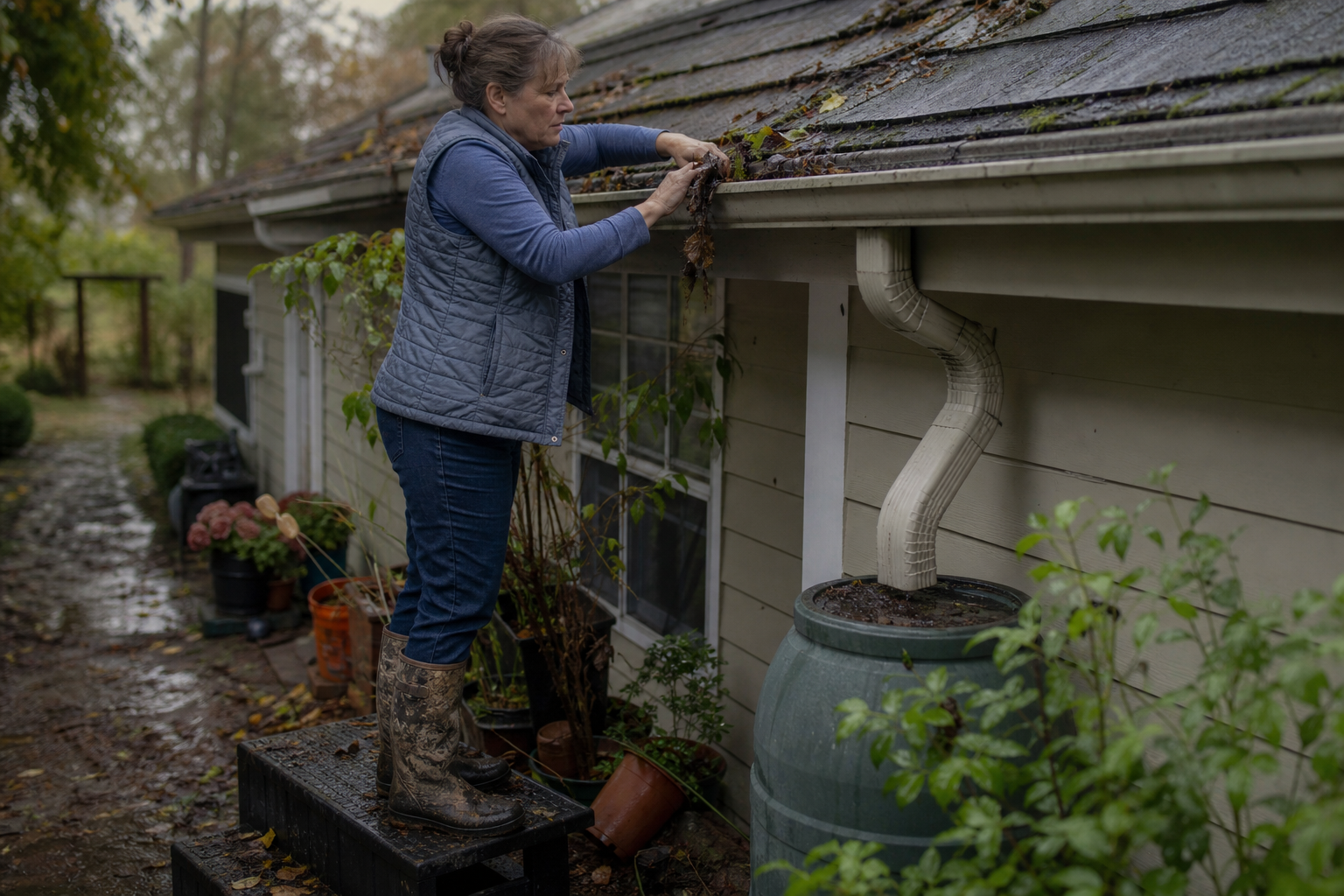
The downspout you cut into used to carry water away from the house. Now it stops at a barrel. Once that barrel is full, whatever the roof delivers pours out of the top, straight down at the base of the wall you just spent money waterproofing.
So the overflow port is not an accessory, it is the point. Put a bulkhead fitting near the top of the barrel, sized at least as large as the inlet, and run a hose from it to somewhere the water was always going to end up: a swale, a rain garden, the original underground drain, or simply ten feet downhill. If the overflow line is narrower than the inlet, it backs up and the barrel overflows from the lid anyway.
Better still, link barrels. Connect them low to low so they fill and drain as one vessel, and take the overflow off the last barrel in the chain. Three barrels in series is 165 gallons for not much more work than one.
The parts that matter
- A downspout diverter rather than a cut-and-hope. A diverter sends water to the barrel until it is full, then passes the rest down the original downspout by itself. It solves the overflow problem and the winter problem at the same time.
- A solid, opaque barrel. Light gets in, algae grows. A translucent barrel turns green in one season.
- Fine mesh screen on every opening, fastened so it cannot lift.
- A brass or good-quality spigot with a bulkhead fitting and washers. Cheap plastic spigots are the number one leak.
- A stand that is genuinely overbuilt. Water weighs 8.34 pounds per gallon, so a full 55-gallon barrel is about 460 pounds sitting on four small feet.
Why your barrel has almost no pressure
Gravity gives you 0.433 psi for every foot of height between the water surface and the outlet. A barrel on a two-foot stand, full to the top, gives you roughly 1.5 psi at the spigot, dropping toward zero as it empties. Your house plumbing runs at 40 to 60 psi.
That means a sprinkler will not work, a hose-end nozzle will not spray, and a standard drip system with pressure-compensating emitters will not reach its operating pressure. What does work is a soaker hose laid flat and short, a watering can, or a small 12-volt pump if you need real flow. Raising the barrel helps but not as much as people hope: going from two feet to four feet only doubles a very small number.
Mosquitoes, and the maintenance nobody mentions
Standing water outdoors in summer is mosquito habitat, and a rain barrel is standing water by definition. The fix is mechanical: every opening screened with mesh fine enough that a mosquito cannot pass, including the inlet, the overflow outlet and any gap around the lid. Mosquitoes are persistent about finding the one corner where the screen has lifted, so check it, and check it again after every storm that moves debris.
The second half is turnover. Water that sits for weeks goes stagnant and smells. Use the barrel regularly, even if that just means emptying it onto the garden before a forecast storm so you have capacity for the new water. A barrel you draw down every week never develops a problem.
Twice a season, pull the screen, scoop the sludge of grit and shingle granules off the bottom, and rinse. That sediment is where the smell lives.
Winter: drain it or lose it
Water expands when it freezes and a full barrel will split, usually at the spigot or the bottom seam. Before your first hard freeze, open the spigot, leave it open, disconnect the diverter so the downspout runs normally again, and either flip the barrel upside down or store it. A diverter with a winter position makes this a two-minute job instead of an afternoon.
What the water is good for
Safety: roof runoff is not drinking water. It carries whatever is on the shingles, in the gutter and in the air, and asphalt roofs shed granules and organic debris continuously. Treat rain barrel water as irrigation and flush water unless you have built a proper first-flush and filtration setup and tested the result.
Where it earns its keep is garden beds, ornamentals, washing tools, topping up a pond, and flushing toilets during an outage, which is a genuinely useful thing to have 165 gallons of. We go deeper into the treatment question in is rainwater safe to drink, and into what your state allows in is collecting rainwater illegal in your state, which is worth five minutes before you buy anything.
One practical note for anyone with a flock: a barrel positioned uphill of the coop makes filling waterers a gravity job instead of a bucket-carrying job, which matters more than it sounds in a backyard chicken coop routine you repeat twice a day.
The setup I would build
Three opaque food-grade barrels on a level, compacted gravel pad with a heavy timber or concrete block stand about two feet high. Linked low to low with bulkhead fittings. A proper downspout diverter feeding the first barrel, screened at every opening, a brass spigot on the first barrel and an overflow off the third running to a swale downhill. Drained and disconnected every November.
That is a couple of hundred dollars in parts and it will still be working in ten years. The single-barrel kit sold at the garden center will be cracked, green and full of larvae by the second August, and it will have been dumping storm water into your foundation the whole time.
Amazon affiliate links follow. As an Amazon Associate I earn from qualifying purchases, at no extra cost to you. Details
Rain Harvesting first flush diverter kit on Amazon →
As an Amazon Associate I earn from qualifying purchases.
Frequently Asked Questions
How high does a rain barrel need to be off the ground?
High enough to fit a watering can under the spigot, which is about 18 to 24 inches. Going higher adds pressure at a rate of 0.433 psi per foot, so it is not worth building a tower for. If you need pressure, use a pump.
Can I use a rain barrel on a metal roof?
Yes, and metal generally sheds less debris than asphalt shingle. Older roofs may have lead-containing flashing or paint, so if you are considering anything beyond irrigation, find out what the roof and its fasteners are made of first.
Do I need a first-flush diverter for garden use?
Not strictly, but it cuts the sediment load noticeably, which means less sludge and less smell. A first-flush device dumps the initial gallons that carry the dirtiest runoff before the rest reaches the barrel.
Why does my rain barrel smell like a swamp?
Organic sediment on the bottom breaking down anaerobically, usually combined with light reaching the water. Empty it, scrub out the sludge, screen the openings properly, block the light, and use the water often enough that it turns over.
What to Read Next
- Is rainwater safe to drink? Roof, filter, risk
- Is collecting rainwater illegal in your state
- Emergency water storage that actually works
- The water hub
Disclosure: this page contains an affiliate link. If you buy through it, Failsafe Home earns a commission and you pay exactly the same price. It does not influence what gets recommended here. More detail on our affiliate disclosure page.