
The thirty person-meals on this page are the part people get wrong, usually by buying a bucket they never open. This is a book of pantry recipes and preservation methods for food you would eat on an ordinary Tuesday, which is the only kind that rotates itself. One-time payment, 60-day ClickBank refund window.
Affiliate link: we earn a commission if you buy, at no extra cost to you. The description above comes from the seller’s own page and we have not independently verified it. Details
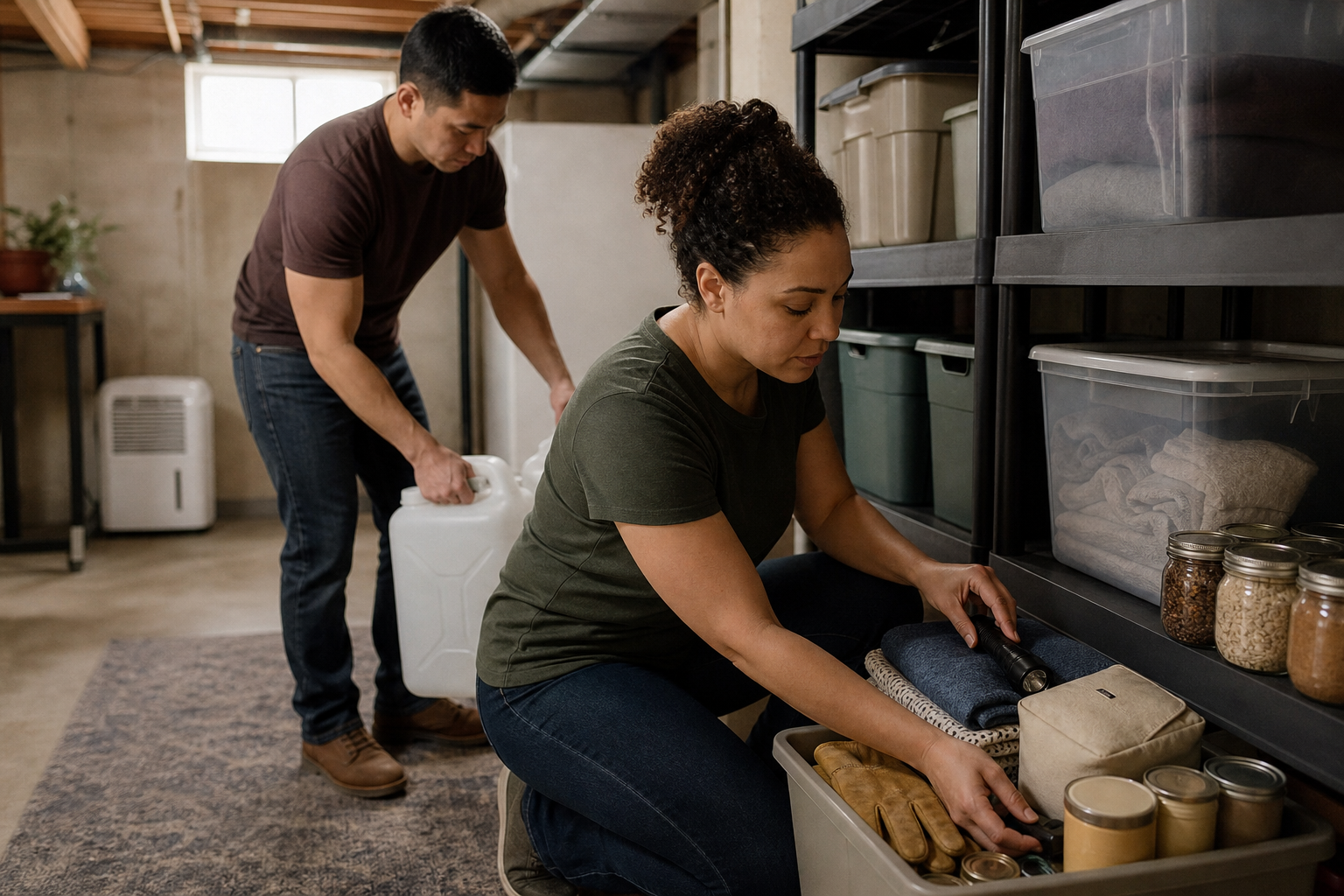
See the recipe list →Nearly every 72-hour kit list you will find was designed for someone who is leaving — an apartment dweller with a backpack by the door, heading to a shelter. If you own a house with land, that is not your scenario. You have a well, a septic tank, a freezer full of meat and nowhere better to go. The right kit for you weighs three hundred pounds, lives on a shelf in the basement, and is organized by system rather than packed in a bag.
The bug-out bag answers a question you don’t have
Portability costs you enormously. A backpack kit gives you a liter of water, a mylar blanket and three energy bars, because that is what a person can carry. The moment you accept that you are staying in the building, every one of those constraints disappears. You can store fifteen gallons of water instead of one. You can keep a case of canned food instead of a pouch. You can own a real headlamp for each person rather than one flashlight for the household.
There is still a case for a small go-bag — wildfire, gas leak, a river that comes up faster than expected. Keep one. But it is a separate, much smaller thing, and it should not be the centerpiece of your planning if the realistic emergency in your county is a four-day ice storm.
What 72 hours actually costs a household
Three days is the standard planning horizon because it covers the large majority of outages and roughly matches how long utilities take to reach scattered rural circuits. For a family of four, three days looks like this in concrete quantities: at least twelve gallons of water for drinking and basic sanitation, more in real heat, plus another five or six gallons if anyone intends to flush a toilet. Around thirty person-meals of food that needs no refrigeration. Enough battery capacity for four headlamps, two phones and a radio to run continuously.
None of that is exotic and none of it is expensive. The reason households do not have it is that it is boring, not that it is hard.
The kit, by system
| System | What goes in it | Family of four, 72 h |
|---|---|---|
| Water | Stored jugs, filter, bleach | 12–18 gallons |
| Food | Canned, dry, no-cook | ~30 meals |
| Light | Headlamps, spare cells | 4 lamps, 24 AA |
| Heat / cold | Wool blankets, bags, fans | 2 bags, 4 blankets |
| Sanitation | Bucket, liners, wipes | 1 kit, 40 liners |
| Power | Power bank, radio, car charger | 2 banks, 1 NOAA radio |
| Health | First aid, CO alarm, med list | 1 kit, 2 alarms |
Store it as one shelf, not scattered through the house. The failure mode of a distributed kit is that the batteries are in the junk drawer, the flashlight is in the truck, and the person looking for both is doing it by phone light at midnight.
Water deserves its own paragraph
The planning figure is a gallon per person per day for drinking and sanitation, and it doubles in very hot weather. Children, nursing mothers and anyone ill need more. That is the drinking side. Flushing a conventional toilet takes roughly a gallon and a half poured straight into the bowl, which is why the bathtub gets filled in the first ten minutes of an outage — while the well pressure tank still has something in it.
Water you bottled yourself in food-grade containers should be rotated every six months. Commercially sealed bottles keep far longer in a cool, dark place. Add a gravity filter or a hollow-fiber straw so that pond, creek or rain barrel water becomes a fallback rather than a gamble; our storage guide covers the container types that actually survive a basement.
The parts of the kit that are not supplies
- Cash in small bills. Card readers fail with the same outage, and rural stores go cash-only fast.
- A written list of prescriptions with doses, plus doctor and pharmacy numbers, on paper.
- Photos of insurance policies, deed and IDs on a thumb drive and in the cloud.
- The manual release cord for the garage door, located and tested once, in daylight.
- The location of the water main shutoff and the well pressure tank valve, known by more than one adult.
- One out-of-area contact everyone in the family calls, because local circuits congest and long distance often still routes.
Safety: Two things belong in every house kit and get skipped constantly. A battery carbon monoxide alarm, because generators and unvented heaters come out during exactly these events and CO has no smell. And headlamps instead of candles — open flame in a dark house with tired people and pets is a predictable fire, and fire departments run those calls after every storm.
What we deliberately leave out
Freeze-dried buckets marketed as a year of food. They are expensive per calorie, most households never open one, and the sodium content makes the water problem worse rather than better. Ordinary canned and dry food you already eat is cheaper, rotates by itself, and does not need a stove. If you want to go a step further and put up some of it yourself instead of buying it, a recipe collection like The Lost SuperFoods covers the pantry methods, though it is a cookbook rather than a preparedness plan and will not tell you how many gallons to store.
Also out: stockpiling prescription medication beyond what your pharmacy will legitimately fill, and any product promising to make water out of thin air or electricity out of nothing. Keep the medication conversation with your doctor, keep a written list, and if a device or a device’s battery is keeping someone alive, size that battery properly instead of hoping.
Building it in one afternoon
Buy the water containers and fill them. Pull a case of food off the shelf at the grocery store and label the shelf, not the boxes. Order four headlamps and a bulk pack of the battery size they use. Add a bucket, liners and wipes for the sanitation kit — that is the one people skip and the one that determines whether anyone can stand to stay. Then write the date on a piece of tape and put a calendar reminder six months out to rotate the water.
The whole thing runs a few hundred dollars and takes a Saturday. It is markedly less satisfying than shopping for a generator, and it does more for the first seventy-two hours than a generator does. Once it exists, the larger purchases in the long-outage plan have something to sit on.
Amazon affiliate links follow. As an Amazon Associate I earn from qualifying purchases, at no extra cost to you. Details
Energizer LED headlamps, 4-pack, on Amazon →
Camco bucket toilet seat with lid on Amazon →
Frequently Asked Questions
Do I still need a go-bag if I have a house kit?
Yes, a small one. Wildfire and gas leaks do not negotiate. Keep documents, medication, a change of clothes and a water bottle in a bag by the door — but do not confuse it with your actual preparation.
How much food should I store per person per day?
Plan around 2,000 calories a day for an adult and count meals rather than pounds. Three days for four people is roughly thirty person-meals, which is about one grocery run.
Where should the kit live?
Somewhere cool, dry and reachable without stairs if possible — a basement shelf or a mudroom closet. Avoid unheated garages for anything with batteries, which lose capacity in the cold and can leak.
How often should I check it?
Twice a year, when the clocks change. Rotate homemade water, test the headlamps, check food dates and replace CO alarms at about the five-year mark. Ten minutes, twice, beats a full audit once.
Some of the links above are Amazon affiliate links. As an Amazon Associate I earn from qualifying purchases, at no extra cost to you. Details in our affiliate disclosure.
What to Read Next
- How Long Food Lasts in a Freezer Without Power
- What Breaks First When the Grid Goes Down
- Winter Storm Prep for a House With Land
- What to Do When the Power Goes Out
- All our scenario guides
The book above is linked through an affiliate program: buy through it and Failsafe Home receives a commission, at the same price you would pay anyway. It has not bought its way past the section explaining what we leave out of a kit, and it never will. See our affiliate disclosure.