
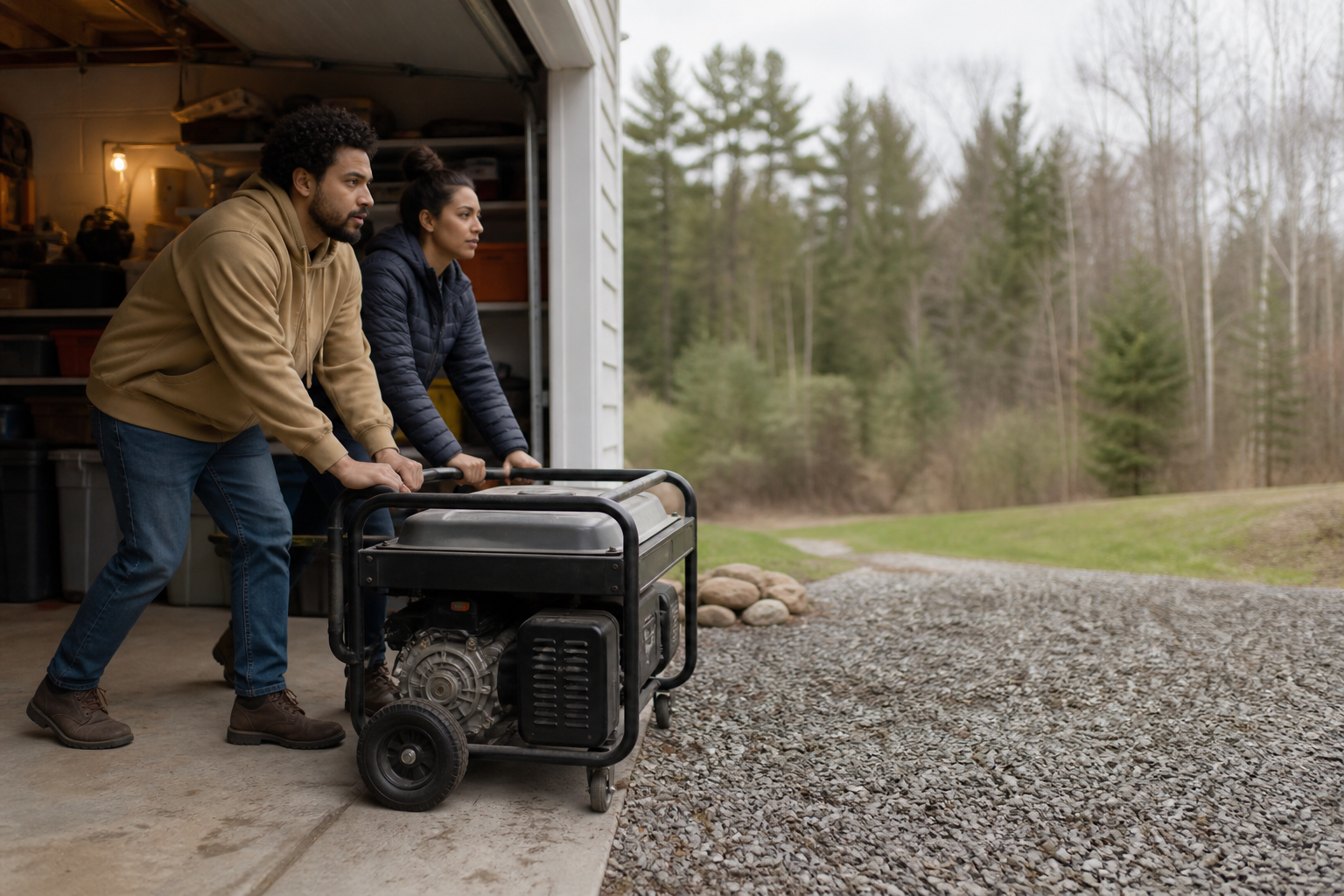
Nearly every household CO poisoning in a blackout traces back to a decision made in the first hour: where the generator went, or what got lit indoors.
What to do when the power goes out →Carbon monoxide poisoning is the most predictable way a power outage turns fatal. The gas has no color, no smell and no taste, it is produced by everything people improvise with when the grid goes down, and its early symptoms are close enough to winter flu that families sit in it for hours. The CDC attributes more than 400 deaths and over 100,000 emergency department visits a year in the United States to unintentional, non-fire carbon monoxide exposure. The CPSC puts portable generators alone at an average of about 100 deaths a year.
What It Does Inside You
Hemoglobin, the protein in your red blood cells that carries oxygen, binds carbon monoxide roughly 200 to 250 times more readily than it binds oxygen. When CO is present, hemoglobin picks it up preferentially and holds onto it, forming carboxyhemoglobin. Your lungs work fine, your blood circulates fine, and your tissues starve anyway because the delivery trucks are full of the wrong cargo.
That mechanism explains the symptom pattern. The organs that complain first are the ones with the highest oxygen demand — brain and heart — which is why the early signs are headache and muddled thinking rather than anything respiratory. It also explains why fresh air alone is slow: it takes hours for the body to clear carboxyhemoglobin breathing ordinary air, and much less on the high-flow oxygen an ambulance carries.
The Symptoms
The CDC’s list of common carbon monoxide poisoning symptoms is short and worth knowing by heart:
- Headache — usually the first thing, often dull and across the forehead
- Dizziness and weakness
- Upset stomach and vomiting
- Chest pain
- Confusion
At higher exposures people lose consciousness. Someone who is asleep or has been drinking can die without ever experiencing a symptom they could act on, which is why bedrooms are where CO kills. Infants, older adults, and people with chronic heart disease, anemia or breathing problems are affected at lower concentrations than a healthy adult.
Why Everyone Calls It Flu
Headache, nausea, fatigue and dizziness in January describes both. Three details separate them, and they are the details to check before you decide it is a virus.
| Clue | Flu | Carbon monoxide |
|---|---|---|
| Fever | Usually present | Absent |
| Who is sick | One or two, staggered | Everyone at once, pets too |
| Leaving the house | No change | Symptoms ease outdoors |
That third row is the strongest single test available to a layperson. If the whole household feels rough indoors and noticeably better an hour after going outside, and worse again after coming back in, treat that as carbon monoxide until a professional tells you otherwise. Pets are a useful early warning — a dog or bird that seems ill at the same time as the people is not a coincidence.
Where It Comes From When the Power Is Out
- A portable generator too close to the house. The overwhelming leading cause. Garages, carports, porches, basements and sheds all count as too close, open door or not.
- Charcoal or a gas grill brought indoors or into the garage for cooking or heat. Charcoal in particular produces enormous quantities of CO.
- Camp stoves and unvented propane or kerosene heaters run in a sealed-off room — precisely the room people seal to conserve heat.
- A car or truck idling in an attached garage to charge phones or warm up.
- Blocked or snow-covered vents. A drifted-over sidewall vent on a furnace or water heater backs combustion gases into the house, and this one gets people whose power came back on.
- A fireplace with a closed or partly blocked damper, or a chimney that has not been swept.
The distance rule for generators is more than 20 feet from any window, door or vent, exhaust pointed away from the house. Twenty feet is not a suggestion derived from nothing — CPSC testing found lethal concentrations building inside homes from generators run in attached garages with the door open.
What to Do Right Now
Safety: If you suspect carbon monoxide, get every person and pet out of the building into fresh air immediately, and call 911 from outside. Say that you suspect carbon monoxide poisoning so responders arrive prepared. Call 911 without delay if anyone is unconscious, confused, vomiting, having chest pain or trouble breathing, or cannot walk out on their own — do not drive them yourself if they are that unwell. Do not go back inside to open windows, find the source or collect belongings; CO impairs judgment and people collapse mid-errand. Do not re-enter until the fire department or a qualified technician clears the building. Anyone who is pregnant, has heart or lung disease, or was found unresponsive should be seen by a clinician even if they perk up in fresh air. This page is general information, not medical advice, and never a substitute for emergency care.
One thing worth knowing before you decline the ambulance: a portion of people who recover from significant CO exposure develop delayed neurological symptoms — memory problems, difficulty concentrating, mood changes — days to weeks afterward. Feeling better outside does not mean the exposure was trivial, and a documented evaluation matters if problems appear later.
Cutting the Odds Before the Next Outage
Decide where the generator goes now, in daylight, with a tape measure, and mark the spot. In a sleet storm at 11 p.m. with a house full of cold children, nobody measures anything — they put it under the eave where the cord reaches. Buy the longer cord in advance so the safe spot is also the convenient one.
Have battery-powered CO alarms, or plug-ins with battery backup, on every level and outside every sleeping area, and check that none of them is past its replacement date before winter. A hardwired alarm with no battery is dead in exactly the scenario this article is about. Then walk the outside of the house after any heavy snow and clear the furnace and water heater vents.
The Thing to Actually Carry Away
Everyone in the house sick at once, no fever, better outdoors. That triad is the whole article compressed into eleven words, and it is the pattern that gets missed at two in the morning by an adult who is already too foggy to reason well. Say it out loud to the household before storm season so somebody recognizes it while they still can.
Frequently Asked Questions
How long does it take to get carbon monoxide poisoning?
It depends entirely on concentration. At the levels a generator in an attached garage can produce, serious symptoms can develop within minutes. At low levels from a slightly faulty appliance, it can take days and look like a lingering illness.
Can you smell carbon monoxide at all?
No. Carbon monoxide itself is odorless. You may smell exhaust or unburned fuel alongside it, but the absence of any smell tells you nothing, and plenty of dangerous exposures come with no odor at all.
Is opening a window enough to make a room safe?
No. Cracked windows do not provide anything close to the air exchange needed to keep up with a running engine or an unvented burner, and the belief that they do is behind many garage and basement deaths.
How long does carbon monoxide stay in your system?
Breathing normal air, carboxyhemoglobin takes several hours to fall by half. High-flow oxygen in an ambulance or emergency department cuts that dramatically, which is a large part of why the call matters even when someone feels better outside.
What to Read Next
- Where to put a generator so it doesn’t kill you — the 20-foot rule, measured properly.
- Indoor propane heaters: safe or deadly — the honest version of the “safe indoors” label.
- Carbon monoxide detectors: placement and failures — what to buy and where it goes.
- Hypothermia indoors when the heat fails — the other cold-weather emergency that starts with confusion.