
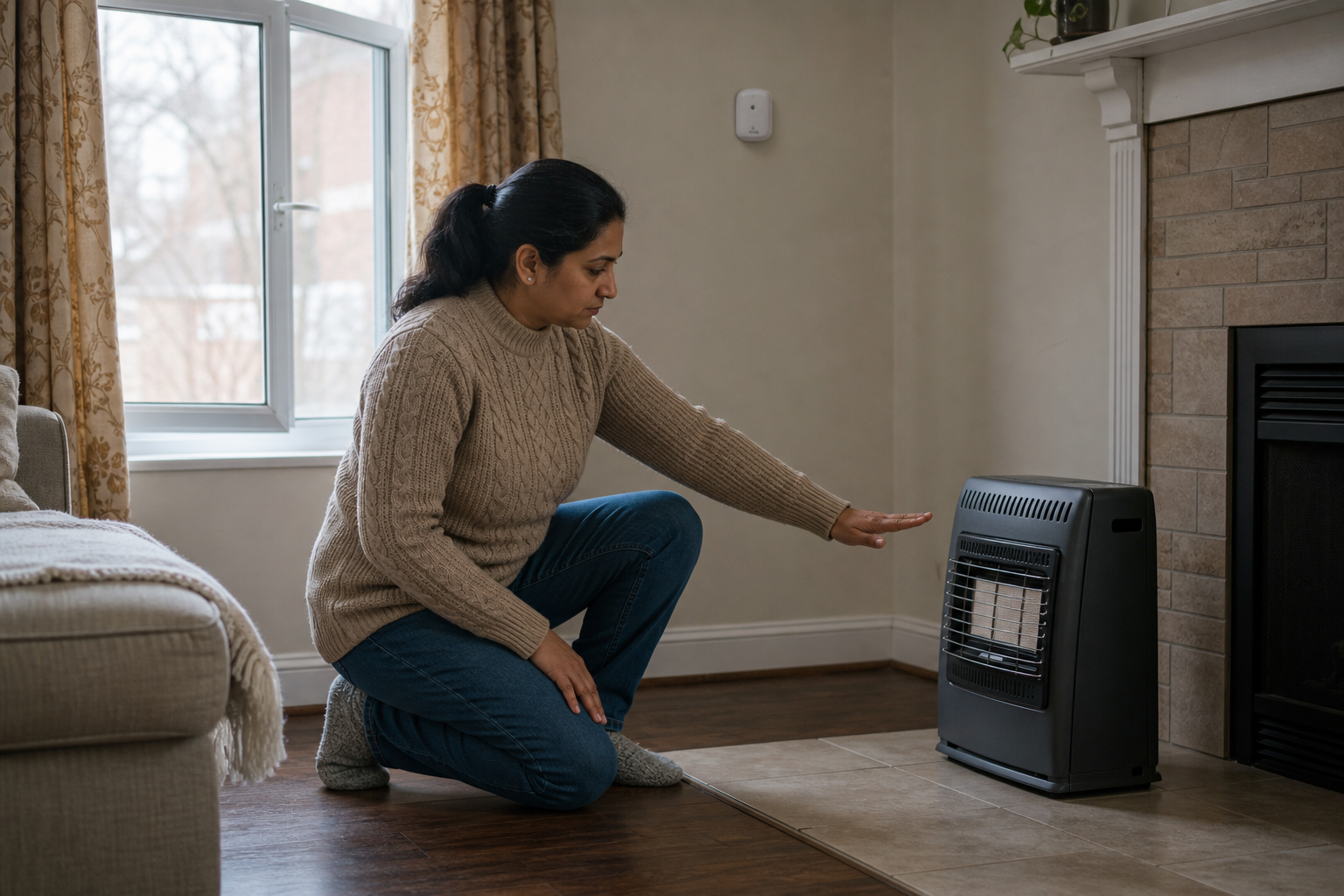
No unvented heater belongs in a room without a working CO alarm on the same level. Placement and failure modes, in plain terms.
Read the detector guide →An unvented propane heater is the cheapest way to keep one room of a house habitable when the furnace stops. It is also the appliance most likely to kill the people sleeping in that room. Indoor propane heater safety comes down to three things you can verify yourself: whether the burner has an oxygen depletion sensor, whether the room gets real air exchange, and whether a carbon monoxide alarm is running in the same space. Everything past that is packaging copy.
What “indoor safe” on the box actually means
Unvented means exactly what it sounds like: every product of combustion stays in the room with you. Carbon dioxide, water vapor, trace nitrogen oxides, and whatever carbon monoxide the burner produces. There is no flue. The heater is not “clean” — it is simply small enough that a normally ventilated room can absorb the output.
The line between a heater that is sold for indoor use and one that is not is a voluntary standard, ANSI Z21.63. It says that when the heater runs in a 100-cubic-foot test chamber at air exchange rates of 0.5, 1.0 and 1.5 air changes per hour, carbon monoxide in that chamber must stay under 100 ppm. That threshold is the entire basis for the phrase on the carton.
CPSC ran that test on a batch of portable propane radiant heaters and published the numbers in 2002. Of six units without an oxygen depletion sensor, none complied. Single-burner heaters peaked between 358 and 368 ppm. Radiant heater/cooker combination units ranged up to 2,124 ppm. The two units that did have an oxygen depletion sensor both passed, and their peak carbon monoxide readings were 38 and 39 ppm — roughly an order of magnitude lower.
The ODS shuts off the gas, and that is all it does
An oxygen depletion sensor is not an electronic sensor. It is a pilot flame aimed precisely at a thermocouple. When the oxygen concentration in the room falls, the flame changes shape and lifts away from the thermocouple, the thermocouple cools, and the gas valve closes. In the CPSC testing the sensors tripped in a band between 18.8 and 19.6 percent oxygen — well before the 16 percent point where carbon monoxide production climbs sharply.
Two consequences follow, and both matter. First, an ODS measures oxygen, not carbon monoxide. A burner clogged with dust or spider webbing can produce CO while the room oxygen is perfectly normal, and the sensor will happily let it run. Second, an ODS is altitude-dependent, because thin air looks like depleted air to a pilot flame. Mr. Heater rates the Portable Buddy for a maximum elevation of 7,000 feet. Above that the unit nuisance-trips or behaves unpredictably, and no amount of fiddling fixes it.
Ventilation is a number, not a feeling
Here is the figure that reframes the whole product category. CPSC calculated that at 0.5 air changes per hour — a reasonable rate for a moderately tight modern room — a propane heater can only run at about 1,220 BTU/hr before oxygen in the space falls below 16 percent. The low setting on a common portable heater is 4,000 BTU/hr. That is more than three times the input the room can absorb at that ventilation rate.
The heater does not become safe because you feel fine. It becomes safe because air is moving. In a 1960s farmhouse with storm windows and a leaky rim joist, air exchange may genuinely be 1.0 ACH or higher and the math works out. In a house that has been air-sealed and blown-in insulated in the last ten years, it does not. Crack two openings on different walls so there is a path, not one window that just sits there.
| Setting | Input | Rated area | What we do |
|---|---|---|---|
| Low | 4,000 BTU/hr | ~100 sq ft | One window cracked 1 in |
| High | 9,000 BTU/hr | Up to 225 sq ft | Two openings, opposite walls |
| Twin-cylinder | 18,000 BTU/hr | Up to 450 sq ft | Open interior door as well |
| Any setting | — | Bedroom, asleep | Off. No exceptions |
Water vapor is the problem nobody warns you about
Burn propane and you get water. The chemistry is fixed: every pound of propane burned releases roughly 1.6 pounds of water vapor into the room. Run a heater for two evenings in a closed bedroom and you will find condensation streaming down the window glass, damp bedding, and by the end of a week, mildew on the wall behind the headboard. People who use these heaters through a long outage often report the humidity as the thing that eventually drove them out of the room, not the heat or the smell.
It is also a useful indicator. If the windows are running with water, the room is not exchanging enough air, and the carbon monoxide picture is worse than you think.
Where these heaters actually kill people
The fatal cases cluster in a small number of patterns, and none of them involve a properly used ODS heater in a ventilated room.
- Construction heaters brought indoors. Torpedo and tank-top heaters have no oxygen depletion sensor and are not built to a room-air standard.
- Running any unvented heater while everyone is asleep, so nobody notices the headache.
- Enclosed garages, sunporches and campers, where “outside” is technically true and functionally false.
- A gas oven or charcoal used as a heat source. This is the single most lethal cold-weather habit in the country.
- No CO alarm, or an alarm past its replacement date, which CDC puts at about five years.
Safety: Carbon monoxide poisoning presents as headache, dizziness, weakness, nausea, chest pain and confusion — flu without the fever. If more than one person in the house has it at once, or if it improves when you step outside, get everyone out and call 911. Do not go back in to open windows first.
The setup we would actually run
One ODS radiant heater, one room, one 20 lb cylinder outdoors with a filter and a hose through a wall port rather than a 1 lb bottle rattling around inside. Two openings cracked. A battery CO alarm on the floor near the heater and a second one at head height, because CO mixes fairly evenly but the drafts around an unvented burner do not. Heater off before anyone lies down, then blankets and body heat do the overnight work — which is what keeping a house survivable without heat is mostly about anyway.
The honest caveat: this is a bridge, not a plan. It gets a family through three cold days. If your winters routinely knock power out for a week, the money is better spent on a wood stove that runs with no electricity at all or on the generator and transfer switch that keep the existing furnace alive.
Amazon affiliate links follow. As an Amazon Associate I earn from qualifying purchases, at no extra cost to you. Details
Mr. Heater Portable Buddy on Amazon →
Frequently Asked Questions
Can I run a Mr. Heater Buddy in a bedroom overnight?
No. The manufacturer’s own literature is clear that these are not unattended appliances, and sleeping removes the one defense that actually works — a person noticing that something is wrong. Heat the room before bed, shut it down, and sleep under wool.
How much do I need to open a window?
Enough to create a path. One inch at the bottom of a window on one wall and one inch at the top of a door or window on another gives you a low intake and a high exhaust. A single cracked window on one wall moves very little air.
Is a 1 lb cylinder safer than a 20 lb tank indoors?
It is smaller, not safer. The disposable cylinders leak at the valve more often than refillable tanks and are the usual cause of the propane smell people report. Keep the bulk tank outside and bring the fuel in through a hose.
Why does my heater keep shutting off at my elevation?
Because thin air reads as depleted air to the pilot flame. Most portable ODS heaters are rated to about 7,000 feet. Above that, the shutoffs are the sensor working as designed, and there is no legitimate way to defeat it.
Some of the links above are Amazon affiliate links. As an Amazon Associate I earn from qualifying purchases, at no extra cost to you. Details in our affiliate disclosure.