
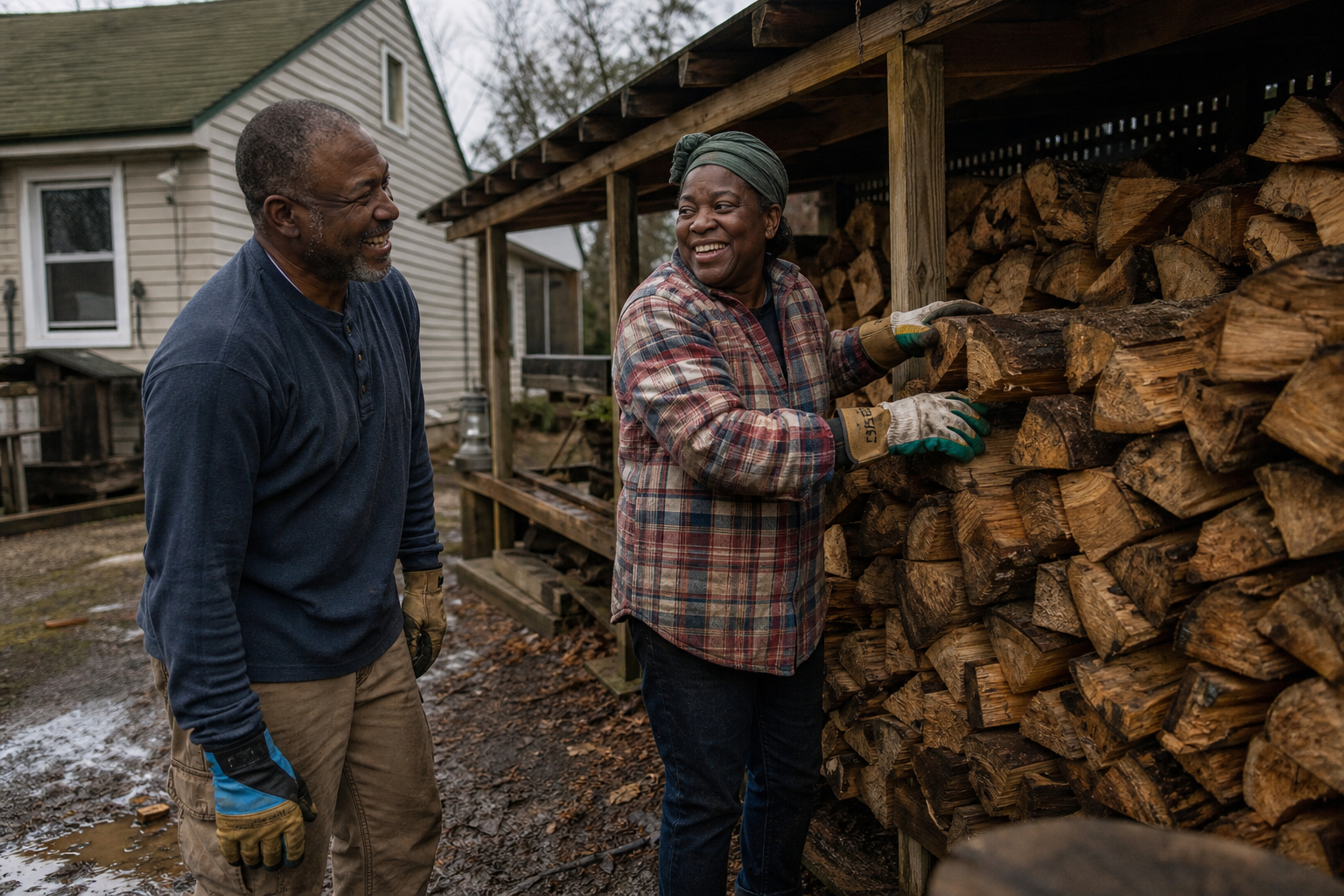
Ron and Johanna’s forty years off-grid, written up as one connected homestead — woodlot, garden, root cellar, water catchment. A one-time payment with the standard 60-day ClickBank refund window.
Affiliate link: we earn a commission if you buy, at no extra cost to you. The description above comes from the seller’s own page and we have not independently verified it. Details
See what’s inside →Seasoning firewood is the cheapest upgrade available to anyone who heats with wood, because it costs nothing but time and planning. The target is well established: burn wood at or below 20 percent moisture content. Freshly cut hardwood is often 50 percent or higher. The gap between those two numbers is the difference between a stove that heats your house and a stove that lines your chimney with creosote and makes you feel like you bought the wrong stove.
Almost everything else in this article follows from getting a stack split, off the ground and into the wind roughly a year before you intend to burn it.
What wet wood actually costs you
Two separate penalties, and people usually only know about the first.
The direct one is evaporation. It takes roughly 1,000 BTU to boil off a pound of water, and a pound of green wood at 50 percent moisture carries half a pound of it. That is somewhere around a tenth of the fuel’s energy spent making steam instead of heat. Annoying, but survivable on its own.
The indirect penalty is worse. All that boiling keeps the firebox cool, and a cool fire does not burn the volatile gases that make up a large share of wood’s energy. Those unburned volatiles go up a cool flue, condense on the inside of it, and become creosote. So wet wood simultaneously gives you less heat, more smoke, more frequent chimney cleaning, and a real chimney fire risk. It is the single most common reason a wood stove disappoints its owner.
Safety: Creosote buildup is what causes chimney fires, and burning unseasoned wood is the fastest way to build it. Have the flue inspected annually and cleaned as needed, keep a working smoke alarm and a battery CO alarm on every level, and never try to burn out a creosote deposit deliberately.
How long it really takes
“A year” is the honest default for most hardwood, split and properly stacked. Some species are faster and oak is famously slower.
| Species | Heat, million BTU/cord | Time to season |
|---|---|---|
| White oak, hickory | ~27-29 | 18-24 months |
| Red oak | ~24 | 12-24 months |
| Sugar maple, beech | ~24 | 9-12 months |
| Ash | ~24 | 6-12 months (dries fast) |
| Birch, cherry, red maple | ~20-21 | 6-9 months |
| Pine, spruce, fir | ~15-20 | 3-6 months |
Those BTU figures are the standard extension-service ranges and vary with density and moisture, so treat them as comparative rather than exact. The practical takeaway is that a cord of oak carries roughly half again the heat of a cord of pine — and takes four times as long to get ready.
Splitting is not optional. Bark is designed to keep water in, so a round log dries through the cut ends only and takes years. Split it and you expose the open grain along the whole length. Split it small if you are behind schedule; a wrist-thick split dries in a fraction of the time a thigh-thick one does.
Stacking that actually dries wood
- Off the ground. Pallets, 4×4 rails, scrap pipe — anything that keeps the bottom course out of the mud. A stack sitting on soil wicks moisture up and rots the bottom row.
- Single rows, not a solid block. Air has to move through. Two rows with a hand’s width between them dry far better than the same wood in one deep pile.
- Face the wind, not the view. Orient rows so prevailing wind blows along their length. Sun helps; wind helps more.
- Cover the top only. A sheet of metal roofing or a tarp over the top course, weighted down, with all four sides wide open. Rain does surprisingly little damage to a well-drained stack; trapping humidity does a lot.
- Never shrink-wrap a stack in a tarp. This is the most common mistake. A fully tarped pile is a humidor. Wood inside it can be wetter after a year than when it went in.
Stack ends need support. Cross-hatched “log cabin” ends work and look impressive; a pair of driven T-posts on each end is faster and does not fall over in February when the pile settles.
Measure it, don’t guess
A pin moisture meter costs roughly $20 to $30 at the time of writing and settles every argument. The trick is where you measure: split a piece open and press the pins into the freshly exposed interior face, across the grain. The outside of a split has been dry for months and will read low even on wood that is soaking inside.
Field signs that back up the meter: seasoned splits are noticeably lighter, have checking cracks radiating from the center of the end grain, the bark comes loose, and two pieces knocked together make a sharp crack rather than a dull thud. A piece that hisses and bubbles at the ends in the stove is telling you plainly that it is not ready.
Buying without getting fleeced
A cord is 128 cubic feet stacked — 4 feet by 4 feet by 8 feet. That is the legal definition in most states and the only unit worth negotiating in. A “face cord” or “rick” is 4 feet by 8 feet by whatever the splits happen to be, usually 16 inches, which makes it about a third of a cord. Sellers who quote in ricks are not necessarily dishonest, but the price per unit heat is three times what it looks like.
“Seasoned” from a dealer means whatever the dealer wants it to mean. Green oak weighs on the order of 5,000 pounds a cord and dry oak around 3,500 to 4,000, so a delivery that overloads the truck is a clue. Bring the meter to the delivery, split one piece, and check. If you are buying for this winter and it reads 30 percent, you are buying next winter’s wood — which is fine if you know that going in and have this year’s already stacked.
Storage near the house
Keep the main stack away from the house — 20 to 30 feet is a reasonable distance for termites, carpenter ants and mice, and it matters more in wildfire country where anything against the siding is a fuel source. Bring in three or four days’ worth at a time to a rack by the stove, where it warms and gives up its last percent or two of moisture. Do not store a winter’s supply in the basement; you are importing insects and adding a large fuel load inside the building envelope.
If wood is your real backup heat rather than an ambiance item, the corollary is that you need next year’s cord already drying while you burn this year’s. That means a two-year rotation and twice the stacking space, which is the part of woodlot management that catches people out in their first season. The authors’ book is useful on exactly this kind of sequencing — it is a lived homestead account rather than a technical manual, so nobody should expect stove installation specs from it, but the “here is what we wished we had set up two years earlier” material is the part that transfers.
What I’d do this weekend
Buy the meter first — it is the cheapest tool in this whole subject and it tells you whether you have a problem at all. Then get whatever you have split and up on pallets in a windy spot with the top covered and the sides open. If you are starting from nothing in October, buy kiln-dried or well-seasoned wood for this winter at the premium price, and simultaneously buy green wood cheap and stack it for next year. One expensive season buys you a permanently cheaper and safer stove.
Amazon affiliate links follow. As an Amazon Associate I earn from qualifying purchases, at no extra cost to you. Details
Pin moisture meter for firewood on Amazon →
Frequently Asked Questions
Can firewood be too dry?
Practically, no, though very dry wood burns fast and hot and can be harder to hold at a low, long burn. Kiln-dried wood at around 10 percent is excellent fuel; you just load smaller and manage the air. Outdoor-seasoned wood tends to equilibrate around 15 to 20 percent anyway.
Does stacking bark up or bark down matter?
Marginally. Bark up sheds rain better on an uncovered stack; bark down lets the split face dry faster. Covering the top properly matters far more than either, and nobody has ever failed to season wood because of this decision.
How much wood does a house burn in a winter?
Enormously variable, but three to five cords is a common range for a stove used as a primary heat source in a cold climate, and one to two for occasional or supplemental use. Track your own first season and you will never have to guess again.
Is it worth burning pine?
Yes, if it is properly seasoned. The old warning that pine causes creosote is really a warning about wet wood — dry softwood burns clean. It gives less heat per cord and you reload more often, which makes it good kindling and shoulder-season fuel rather than a January staple.
What to Read Next
- Wood Stove Heating as Real Backup
- Wood Stove Installation Cost, Broken Down
- Carbon Monoxide Detectors: Placement and Failures
- Winter Storm Prep for a House With Land
There are affiliate links on this page. Buying through them earns Failsafe Home a commission and costs you nothing extra. As an Amazon Associate I earn from qualifying purchases, and it has no effect on what we put in front of you or what we tell you to avoid. See the affiliate disclosure for the full picture.