
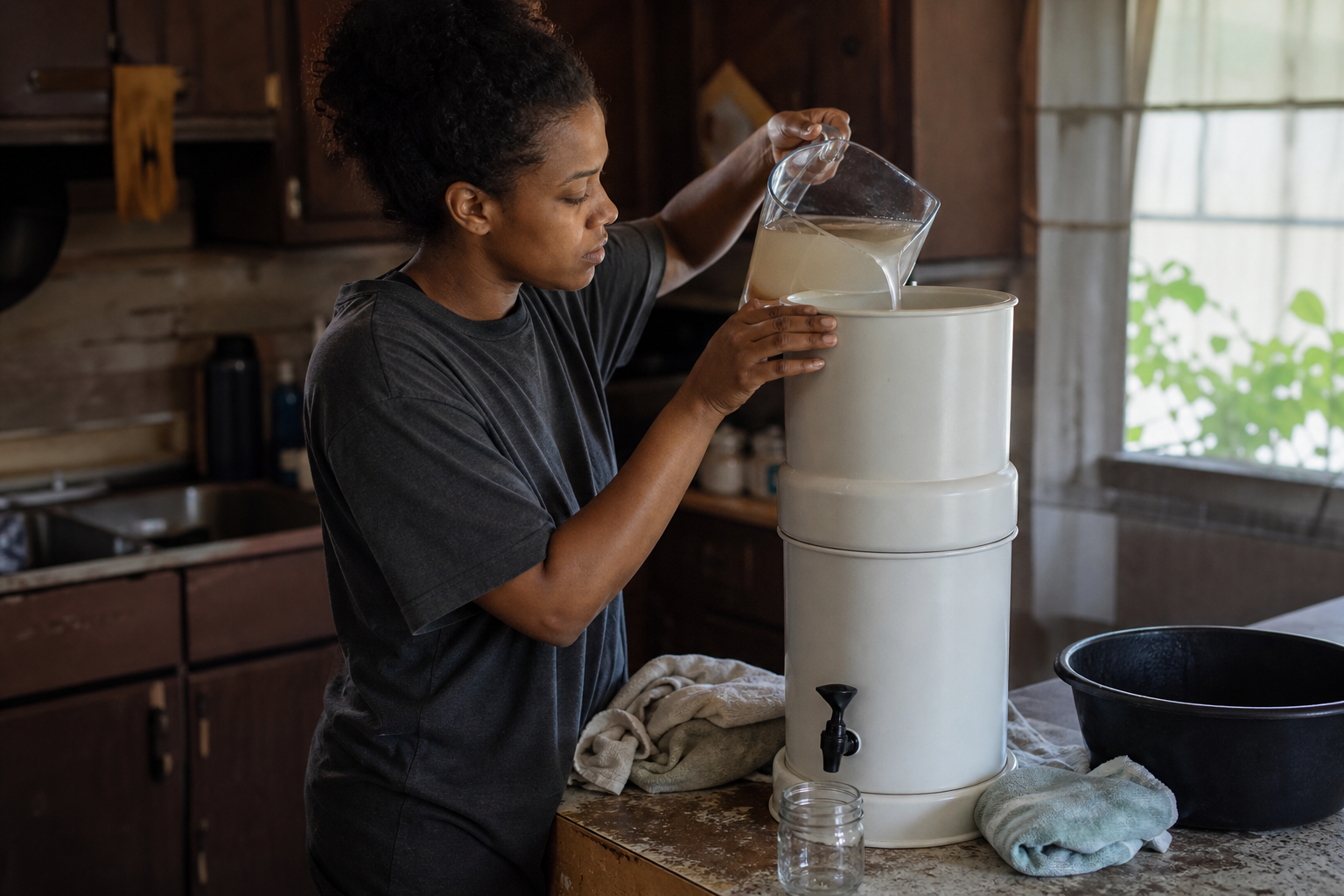
Most gravity units are filters. Whether that is enough depends entirely on what you are pouring into the top.
How a filter chain actually works →Amazon affiliate links. As an Amazon Associate I earn from qualifying purchases, at no extra cost to you. Details
Quick answer: for a house, a countertop stainless gravity filter canister handles daily drinking water with no power; a small gravity kit is the portable backup. Check the certification listed for the exact model and the contaminants you need removed, because not every gravity filter treats bacteria, viruses or chemicals. Examples: Stainless gravity filter canister, 3 gal, on Amazon → Sawyer SP160 gravity kit on Amazon →.
When the power goes out on a well system, the pump stops and so does everything downstream of it. That is the moment a gravity water filter earns its shelf space: no electricity, no pump, no pressure, just a bucket of questionable water on top and drinkable water arriving below. It is the least glamorous piece of water gear in the house and usually the most useful.
The catch is that gravity units are slower than the marketing suggests, and “filter” covers a wide range of actual performance. Here is how they work, what the numbers really look like, and how to pick one that keeps up with a family instead of one person.
How Gravity Filtration Actually Works
Two chambers stacked vertically. You pour raw water into the upper one. The weight of that column of water pushes it through a filter element into the lower chamber. The driving force is head pressure, which is trivial — a foot of water is a bit under half a PSI. Your house plumbing runs at 40 to 60 PSI. That hundred-fold difference in pressure is the entire reason gravity filters are slow.
It also explains the two design families. Hollow-fiber membranes (Sawyer, LifeStraw) use a bundle of straw-like fibers with pores around 0.1 micron; they filter fast but clog fast on turbid water and are ruined by freezing. Compressed carbon-and-media elements (the Berkey style) are slower per element but handle dirtier water and go after taste, chlorine, and some dissolved contaminants that a membrane ignores entirely.
The Flow Rate Nobody Advertises
Manufacturer flow figures are measured with the upper chamber full. A full chamber has maximum head pressure. As the water level drops, flow drops with it, and the last third of a batch takes disproportionately long. In practice, plan on roughly half the advertised rate as a household average.
| Type | Rough output | Best at | Weak point |
|---|---|---|---|
| Two-element gravity canister | ~1-2 gal/hr | Turbid water, taste, chlorine | Slow; elements need priming |
| Four-element gravity canister | ~2-4 gal/hr | Family of four or more | Cost, counter space |
| Hollow-fiber bucket kit | ~2-5 gal/hr when clean | Cheap, fast, DIY | Clogs on silt; freeze-fatal |
| Hanging gravity bag | ~1-2 gal/hr | Portability | Small batch, fragile bag |
Use a gallon per person per day for drinking and cooking as your planning floor — the full sizing logic is in how much water to store per person per day. A family of four needs four gallons minimum out of that filter daily, and realistically closer to six once you add tea, dishes, and the dog. A unit doing one gallon an hour handles that fine as long as somebody keeps the top chamber loaded. A unit doing one gallon an hour that you only refill at breakfast does not.
What They Remove and What They Don’t
This is where the category gets muddy, because the interesting claims are usually the least verified ones.
- Bacteria and protozoa. Any reputable gravity element handles E. coli, salmonella, giardia, and cryptosporidium. This is the easy part, and it is also the part that matters most in a US grid-down scenario.
- Viruses. Most hollow-fiber filters do not claim virus removal, because viruses are smaller than the pores. A device only earns the word “purifier” if it addresses viruses too. If your source is a pond downstream of anything, this matters.
- Sediment and taste. Carbon-based elements do this well. Membranes do sediment but not taste.
- Nitrate, arsenic, and salt. Essentially no. These are dissolved ions and need reverse osmosis, distillation, or a specific ion-exchange media. A gravity filter will not fix a nitrate problem on your well — see testing well water for how you would even know you have one.
- Fluoride and heavy metals. Some units sell add-on elements for these. Read what the actual lab report tested, at what contact time, with what water.
The Certification Question
Third-party certification to NSF/ANSI standards 42, 53, or 401 means an independent body tested the claim and audits the factory. Plenty of good gravity filters are not certified — certification is expensive and voluntary — but there is a difference between “not certified” and “certified against a standard the manufacturer invented.”
Berkey is the case study here. It is the best-known gravity brand in the country, and its performance claims rest on lab tests it commissioned rather than NSF certification of the finished system. In 2023 the EPA issued a stop-sale order against Berkey International under federal pesticide law over how those antimicrobial claims were made and registered; the company sued the EPA in response and the dispute worked through the courts. None of that proves the filter is bad. It does mean you should read the claims as claims.
Two Things That Ruin Gravity Filters
First, freezing. A wet hollow-fiber element that freezes gets microscopic cracks in the fibers. The filter still flows. It still looks fine. It no longer filters, and there is no way to see the failure. If a bucket kit lives in an unheated garage in Minnesota, it is decoration. Store elements dry indoors, or accept that you replace them after any hard freeze.
Second, letting them dry out mid-life. Carbon elements that have been used and then stored damp grow things. Elements that dry completely after use often need re-priming — forcing water through them under tap pressure with a rubber washer — before they will flow again. Half the “my filter stopped working” complaints are unprimed elements, and that is a five-minute fix nobody reads about until the outage.
Safety: A gravity filter is not a substitute for boiling during a confirmed contamination event unless the unit is rated for viruses and you trust that rating. When a boil water advisory is in effect, boil. Filter afterward for taste if you like.
Pre-Filter Your Pre-Filter
The single cheapest upgrade to any gravity system is a bandana, a coffee filter, or a paint strainer bag over the top chamber, plus letting cloudy water settle for a few hours before you pour. Silt is what kills flow rate, and every gram of it you keep out of the element buys you weeks of service life. People who complain their filter slowed to a trickle in three days are almost always running muddy water straight into it.
The other half of the equation is having water on hand at all, so the filter has something to work on. Stored barrels, a filled tub, and a rain barrel all feed the same funnel — emergency water storage that actually works covers the volumes, and the water section ties the pieces together.
My Take
For a house on a well, I would put a four-element carbon-style canister on the counter and a hollow-fiber bucket kit in the closet as the backup, kept dry and indoors. The canister does the daily volume and handles bad-tasting water; the bucket kit is the thing you hand to a neighbor or take to the cabin. Total spend at the time of writing is somewhere in the low hundreds, which is less than a single week of bottled water for four people.
What I would not do is buy a gravity filter and consider the water problem solved. Filtration is the last step. Getting water into the house when the pump is dead is the first one, and it is a bigger project.
Amazon affiliate links follow. As an Amazon Associate I earn from qualifying purchases, at no extra cost to you. Details
Stainless gravity filter canister, 3 gal, on Amazon →
Sawyer SP160 gravity filtration kit on Amazon →
Frequently Asked Questions
How long do gravity filter elements last?
Manufacturers quote thousands of gallons per element, but that assumes clean input water. On silty or high-iron water expect a fraction of it. Track gallons with a tally on the lid rather than trusting the box.
Can a gravity water filter make pond water drinkable?
It can remove the bacteria and protozoa. It will not remove agricultural runoff, fuel, or viruses unless specifically rated to. Settle it, pre-strain it, filter it, and boil it if you have any doubt about the watershed.
Do I need a gravity filter if I have a well?
Yes, because a well without power is just a hole. The filter is what lets you use stored, hauled, or captured water safely while the pump is down.
Is a DIY bucket gravity filter any good?
Two food-safe buckets and a hollow-fiber element with a bulkhead fitting works well and costs a fraction of a branded canister. Use genuinely food-grade buckets, keep it out of the cold, and label it so nobody drinks from the top one.
Some of the links above are Amazon affiliate links. As an Amazon Associate I earn from qualifying purchases, at no extra cost to you. Details in our affiliate disclosure.