
Ron and Johanna’s account of roughly 40 years off grid, including the three-barrel rainwater catchment they ran, the root cellar, the greenhouse and the coop — written as built projects rather than theory.
Affiliate link: we earn a commission if you buy, at no extra cost to you. The description above comes from the seller’s own page and we have not independently verified it. Details
See what’s inside →Long term water storage is the one prep where the substance itself cannot expire. Pure water has no shelf life. Everything that goes wrong in a stored container is something else — what was already in the water, what came in through the plastic, or what grew once the chlorine gave up. Get those three under control and stored water keeps for years.
How much, before anything else
CDC’s floor is one gallon per person per day for three days, with a recommendation to build toward two weeks if you have the room. One gallon covers drinking and minimal cooking. It does not cover washing, and it does not cover the toilet. Real household consumption in a two-week outage, with people cleaning and cooking properly, runs closer to two or three gallons per person per day.
Two weeks for a family of four at one gallon a day is 56 gallons, weighing roughly 465 pounds and taking up a serious corner. That weight is why almost every household eventually splits the problem in two: a modest stored volume for drinking, plus a way to keep producing water — a hand pump on the well, rain catchment, or a gravity filter and a nearby source.
What actually goes wrong in a stored container
Four failure modes, in rough order of how often they bite.
- Something was in the container. A milk jug leaves protein and lactose behind no matter how you rinse it, and a juice bottle leaves sugar. Both are food for bacteria. This is the single most common reason stored water turns cloudy and foul.
- Light. Clear containers in a lit room grow algae. Opaque blue or white plastic, or a dark closet, ends that problem entirely.
- Permeation. Polyethylene is slightly porous to vapor. Store a jug next to gasoline, paint or a running car and the water will eventually taste like the garage. It is a real effect and it is the reason water containers should not share a room with fuel — see also how to store gasoline, which wants the opposite environment.
- Chlorine loss. The residual chlorine in municipal water protects it for a while and then dissipates. After that the container is only as clean as it was on the day you filled it, which is why the prep step matters more than the storage step.
Note what is not on that list: the flat taste. Water that has sat for a year loses its dissolved oxygen and tastes dead. That is a palatability problem, not a safety one, and pouring it back and forth between two clean pitchers fixes it in about thirty seconds.
Preparing a container properly
CDC’s procedure for a food-grade container is short: wash with soap and water and rinse, then sanitize with a solution of one teaspoon of unscented household chlorine bleach (5-9 percent sodium hypochlorite) in one quart of water. Swirl it so the solution touches every interior surface including the inside of the cap, leave it at least 30 seconds, drain, and air dry. Utah State’s version for larger vessels works out to about one teaspoon of bleach per five gallons of rinse water.
Safety: Use only plain, unscented bleach — no “splash-less,” no scented, no color-safe formulations, since those contain additives that do not belong in drinking water. Never store water in a container that previously held pesticides, solvents, bleach or any other chemical, no matter how well it was rinsed. And keep the bleach itself somewhere separate from the water, because household bleach loses strength over months and is not a long-term water treatment on its own.
If you are filling from a chlorinated municipal tap, you generally do not need to add anything — the treatment is already in there. If you are filling from a private well or a source with no residual, the common guidance is roughly 16 drops, about a quarter teaspoon, of unscented bleach per gallon, left to stand 30 minutes before sealing. On well water, know what you are sealing in: a current test is worth more than any amount of bleach guesswork.
The six-month rule, and when to ignore it
CDC says replace self-filled water every six months. Utah State says the same. That interval is a conservative default set for a container in an average home, not a measured expiration.
What it is really tracking is chlorine residual and the odds of a slow contamination you cannot see. A sealed, opaque, properly sanitized container in a cool dark basement will be fine considerably longer than six months. The same container in a hot garage, in sunlight, with a lid that has been opened once, will not. If rotating 56 gallons twice a year is the reason you never built the storage in the first place, then rotate annually, keep the containers cool and dark, and keep a filter on hand for the day you use it. Consistent storage beats perfect rotation that never happens.
Commercially bottled water is the exception. It is sealed and treated at the plant, and the printed date is a quality date rather than a safety one. Kept cool and dark, it is the least demanding stored water there is.
Choosing containers
| Container | Volume | Weight full | Best for |
|---|---|---|---|
| Commercial bottled cases | varies | light units | Zero-effort baseline |
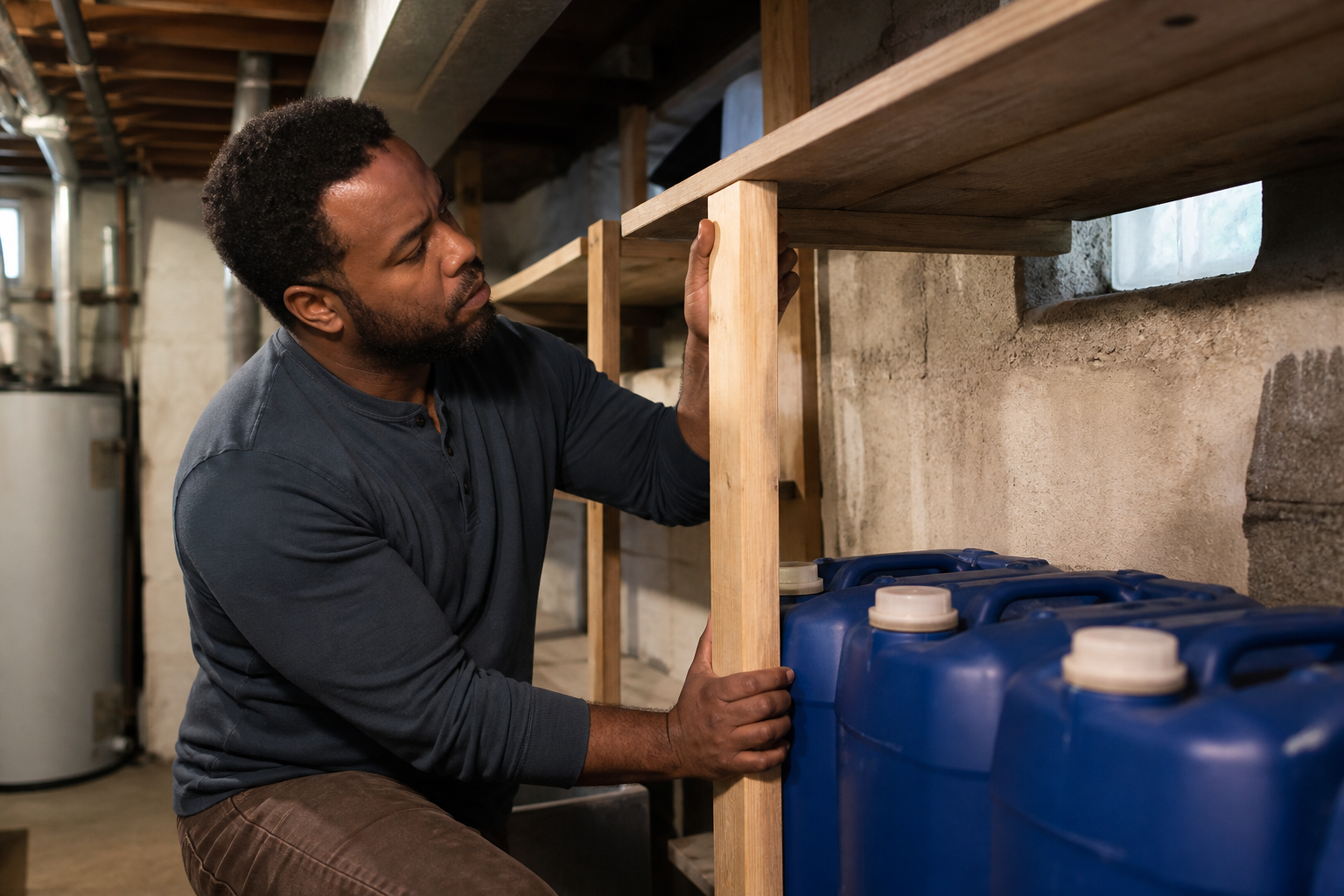
| Stackable bricks (WaterBrick style) | ~3.5 gal | ~29 lb | Carryable, stacks in closets |
| Rigid jerry can | 5-7 gal | 42-58 lb | Moving water around |
| Food-grade drum | 55 gal | ~460 lb | Bulk, never moves once full |
| Bathtub bladder | ~100 gal | n/a | Filled at the warning, not stored |
A drum is the cheapest gallon and the least usable one — full, it never moves again, and you need a siphon or a pump to get anything out of it. The details are worth reading before you commit to one, in storing water in 55-gallon drums. The stackable formats cost several times as much per gallon and are the ones people actually use, because you can pick one up. Most sensible setups mix the two, plus a bathtub bladder for the hours between a forecast and an outage.
Refilling is the real answer
Stored water is a bridge, not a supply. Two weeks is the practical ceiling for most houses, and any disruption longer than that is solved by production instead — a well you can operate without the grid, a rain catchment feeding barrels, or surface water plus filtration. The authors’ three-barrel catchment described in The Self-Sufficient Backyard is a fair example of the low-tech version: settle, store, and treat before drinking. Check what your state allows first, because the rules on collection genuinely differ.
What I would do this weekend
Buy a case of bottled water per person, put it in the coolest dark corner you have, and consider the first three days handled with no maintenance at all. Then add stackable containers over a few months until you reach roughly two weeks, sanitized and filled from the tap, labelled with the fill date on masking tape. Keep them off concrete and away from fuel. Put a calendar reminder on a date you will actually keep — an annual reminder you honor beats a six-month one you ignore — and own a filter, because the moment you need more than what is on the shelf, treatment matters more than storage.
Amazon affiliate links follow. As an Amazon Associate I earn from qualifying purchases, at no extra cost to you. Details
Stainless gravity filter canister, 3 gal, on Amazon →
LifeStraw personal water filter on Amazon →
As an Amazon Associate I earn from qualifying purchases.
Affiliate link: we may earn a commission if you buy.
Water is one of eight readiness areas. See how your household scores across all of them, not just storage, with the seller’s free assessment. Your results are unlocked with your email and consent to the seller’s marketing emails.
Frequently Asked Questions
Does stored water expire?
The water does not. The container and its contents do. Sealed, sanitized, cool and dark, self-filled water is commonly good well past the six-month rotation guidance; hot, sunlit or poorly prepared containers can go bad in weeks.
Can I store water in milk jugs?
No. Milk and juice containers retain proteins and sugars that feed bacteria, and thin HDPE milk jugs become brittle and split within a year or two. Use containers sold for water.
How much bleach do I add to stored water?
Chlorinated tap water usually needs nothing. For untreated water, roughly a quarter teaspoon of plain unscented bleach per gallon, standing 30 minutes. Sanitizing the empty container is a stronger solution and gets rinsed out.
Can I store water containers on a concrete floor?
Put a board or pallet underneath. The old warning about chemicals leaching up through plastic is overstated, but concrete stays damp, holds cold unevenly and abrades the base of a container that gets dragged.
What to Read Next
- Emergency water storage that actually works
- Gravity water filters for a house without power
- When your well loses power
- The Water hub
This site is supported by its readers. One or two links here are affiliate links, meaning a purchase may earn us a commission at no additional cost to you — it buys nobody a place in an article. Read the affiliate disclosure.